How Biweekly Pay Works (And Why 2026 Delivers 27 Paychecks for Some)
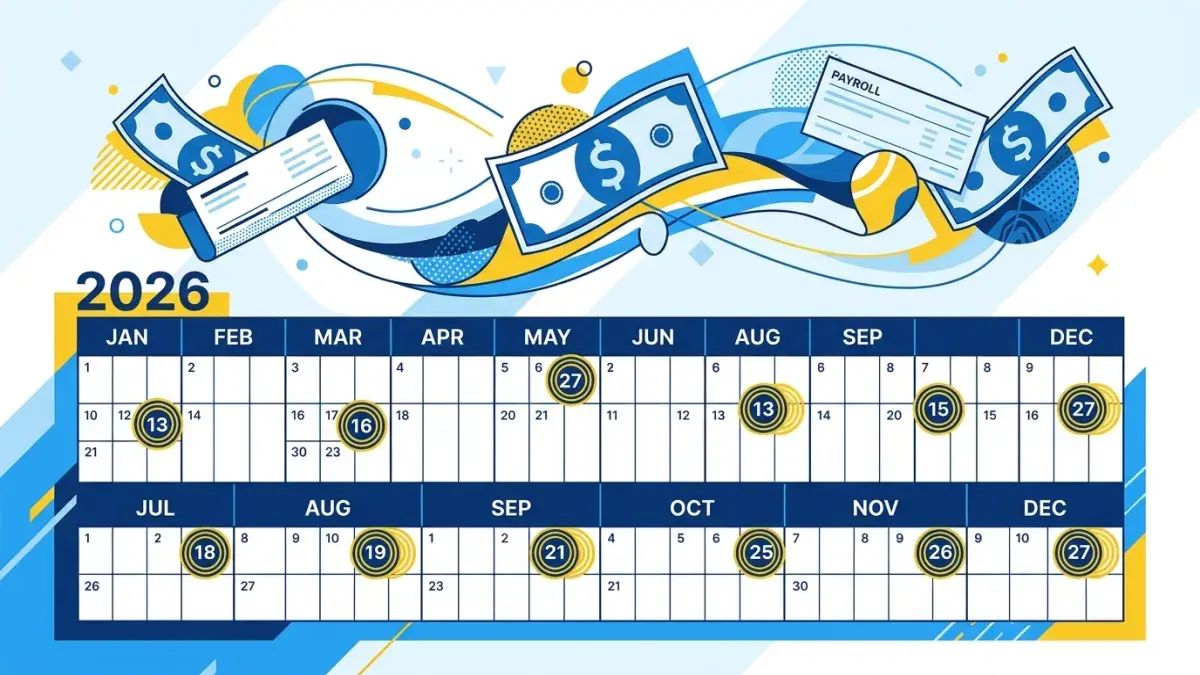
Most biweekly-paid Americans get 26 checks a year. But if your first 2026 paycheck landed on January 1 or 2 (and you are paid on Thursdays or Fridays), congratulations — you probably get 27 biweekly paychecks in 2026. It is not a raise, it is a calendar quirk. Here is how the biweekly cycle actually works, why the 27th paycheck happens, and what it means for your taxes and budget.
The Math That Creates 27-Paycheck Years
A biweekly pay schedule means one check every 14 days. That sounds like 26 checks per year (52 weeks / 2 = 26), and in most years it is. But do the math:
- 26 checks × 14 days = 364 days
- A regular year has 365 days; a leap year has 366 days
- Each year, the biweekly schedule runs 1 day short (2 in leap years)
- That gap accumulates: after ~11 years (or ~6 if leap years align), an extra pay date slides inside the calendar
The specific year when your employer catches an extra paycheck depends on (a) what day of the week your company pays, and (b) when the first paycheck of the cycle falls relative to January 1. For Friday-paying employers, 2026 lands with 27 paychecks if the first 2026 paycheck is January 2, 2026 and the final one falls on December 25 or 18. Verify on your employer’s posted 2026 payroll calendar.
How Employers Handle the 27th Paycheck (Three Approaches)
Method 1: Spread the Salary Over 27 Checks (Most Common for Salaried Employees)
If you are paid an annual salary of $100,000, HR divides it by 27 instead of 26. Each paycheck becomes $3,704 gross ($100,000 / 27) instead of $3,846 ($100,000 / 26). Annual total is unchanged, but each check is 3.85% smaller.
- Pros: Annual compensation exactly matches the offer letter. Tax withholding is proportional.
- Cons: Monthly cash flow drops. Autopay on rent, mortgage, and subscriptions tied to a fixed biweekly amount may clear with less cushion. Employees sometimes feel like they are getting a pay cut in January, which is why smart HR teams send a memo explaining the math ahead of time.
Method 2: Pay the Same Per-Check Amount 27 Times (Common for Hourly Employees)
Hourly workers paid for actual hours worked simply get paid for the hours they log in each 14-day period. An hourly worker putting in 80 hours per pay period at $30/hour gets $2,400 per check regardless of the year. In a 27-paycheck year, the total annual income is $64,800 (vs. $62,400 in a 26-check year) — effectively $2,400 of “extra” pay that shows up as a 27th paycheck.
- Pros: Employee takes home more money. Simpler payroll processing.
- Cons: Additional tax owed because total income rose. Employer’s payroll costs go up ~3.85% that year.
Method 3: Pay a Bonus-Style 27th Check
A handful of employers pay 26 regular salary checks at the usual rate, then issue a separate 27th check at a lower amount (sometimes just the extra day or two of pay the calendar created). This is the least common approach because it generates more payroll confusion than savings.
The Tax Impact of a 27th Paycheck
Whether the 27th paycheck increases your tax bill depends on which method above your employer uses. Scenario comparison on a $100,000 salary, single filer, 2026 federal rates:
| Scenario | Annual Gross | Per Paycheck | Federal Income Tax | Take-Home Per Check | Total Take-Home |
|---|---|---|---|---|---|
| Standard 26-check year | $100,000 | $3,846 | $13,170 | $3,045 | $79,180 |
| Method 1: 27 checks, salary split | $100,000 | $3,704 | $13,170 | $2,933 | $79,180 |
| Method 2: 27 checks, same rate | $103,846 | $3,846 | $14,016 | $3,042 | $82,135 |
Under Method 2, the worker takes home $2,955 more — the 27th paycheck’s net value after tax. Note that the extra gross is taxed at the marginal rate (22% in this example), so the net per the 27th check is slightly less than each of the first 26.
Run the exact numbers for your salary and situation with the salary calculator — flip between 26 and 27 pay periods to see the monthly difference.
The Withholding Quirk Most People Miss
Federal tax withholding tables (IRS Publication 15-T) calculate how much to withhold per paycheck based on assumptions about annual income. If your employer splits your salary across 27 smaller checks (Method 1), the IRS tables may slightly over-withhold, projecting 26 checks for the full year and under-annualizing income. You get that money back at tax time.
If your employer keeps your per-check amount constant (Method 2), annualized income rises by 3.85%. Withholding may under-estimate your actual 27-check total, resulting in a smaller refund or a small balance due. HR departments typically adjust withholding tables for a 27-check year, but not always.
Check: mid-year, pull your pay stub. Multiply year-to-date federal tax by (total pay periods in the year / periods completed). If that projected total is less than your estimated liability (use the take-home calculator for a quick estimate), consider adjusting your W-4 via the IRS’s online withholding estimator.
401(k) Contributions in a 27-Paycheck Year
If you set your 401(k) contribution as a percentage of each check, a 27-paycheck year naturally increases your total annual contribution by about 3.85%. Make sure you do not overshoot the 2026 limit of $24,500 (or $32,500 with catch-up). Many 401(k) systems cap automatically; others do not.
Example: a 10% contribution on $3,846 per check × 27 checks = $10,384 vs. $10,000 on 26 checks. Small difference, but worth checking. For dollar-denominated contributions ($800 per check), a 27-check year also bumps your annual total.
Biweekly vs. Semi-Monthly: What’s the Difference?
These are two completely different schedules, often confused:
| Feature | Biweekly | Semi-Monthly |
|---|---|---|
| Frequency | Every 14 days | Twice a month (e.g., 1st & 15th) |
| Paychecks per year | 26 (sometimes 27) | Exactly 24 |
| Per-check amount on $100K | $3,846 | $4,167 |
| “Bonus” check months | Yes — two per year have three pay dates | No — always two per month |
| Overtime calculation | Pay period aligns with workweek | May cross workweeks, complicating OT |
| Cash flow predictability | Same amount every 14 days | Same dates monthly, varies slightly |
| Common in | Hourly, union, retail, tech | Salaried professionals, finance, real estate |
Hourly workers almost always prefer biweekly because it aligns cleanly with the 40-hour FLSA workweek. Salaried professionals often prefer semi-monthly because paydays align with rent-due and bill-due dates on the 1st and 15th. For overtime rules specifically, see our overtime pay calculator.
How to Budget for a 27-Paycheck Year (Method 2)
If your employer uses Method 2 and you get an extra paycheck in 2026, treat it as unexpected money, not monthly income. Three solid uses:
- Roth IRA contribution: 2026 limit is $7,000 ($8,000 if age 50+). The 27th check nearly fully funds a Roth IRA for most workers. Plan contribution before April 15, 2027 for the 2026 tax year.
- Emergency fund boost: If your savings is less than 3 months of expenses, route the entire 27th check there. Use a savings goal calculator to size your target.
- High-interest debt payoff: A 27th paycheck applied to credit card debt at 22% APR can save hundreds in interest. Use the loan payoff calculator to run payoff scenarios.
How to Budget for a 27-Paycheck Year (Method 1)
If your salary is spread across 27 smaller checks, your biweekly income drops by 3.85%. Tools to protect cash flow:
- Autopay amounts tied to per-check deposit: verify rent, mortgage, insurance, and subscriptions still clear.
- Pre-tax contribution stability: if your 401(k) is a percentage, no action needed. If it is a dollar amount, confirm the total annual target.
- Mid-year check: use the salary calculator to verify gross annual still matches expectation.
What Year is the Next 27-Paycheck Year?
For Friday biweekly payers whose last 2025 paycheck fell on December 26, 2025, the 27-paycheck cycle repeats in approximately 2037. Leap years (2028, 2032, 2036) can shift the timing. Some Thursday payers will see their next 27-check year in 2032.
The exact calendar is employer-specific. HR or payroll can tell you whether 2027, 2028, 2029 (and so on) have 26 or 27 pay dates. Most payroll systems (ADP, Gusto, Paychex, Rippling) pre-publish multi-year calendars.
Sources and Methodology
Federal tax brackets and withholding methodology: IRS Publication 15-T (2026 Federal Income Tax Withholding Methods). FICA wage base: SSA 2026 Contribution and Benefit Base. Pay frequency definitions and labor law references: U.S. Department of Labor State Payday Requirements.
Biweekly calendar math verified against 2026 Gregorian calendar. Last updated April 18, 2026.
Frequently Asked Questions
Calculate Your Biweekly Paycheck
Convert your annual salary into exact biweekly, semi-monthly, monthly, and weekly pay. See how 26 vs 27 paychecks change your cash flow.
Open Salary Calculator →