Bonus Tax: Flat 22% vs Aggregate Method (IRS Pub 15-T, 2026)
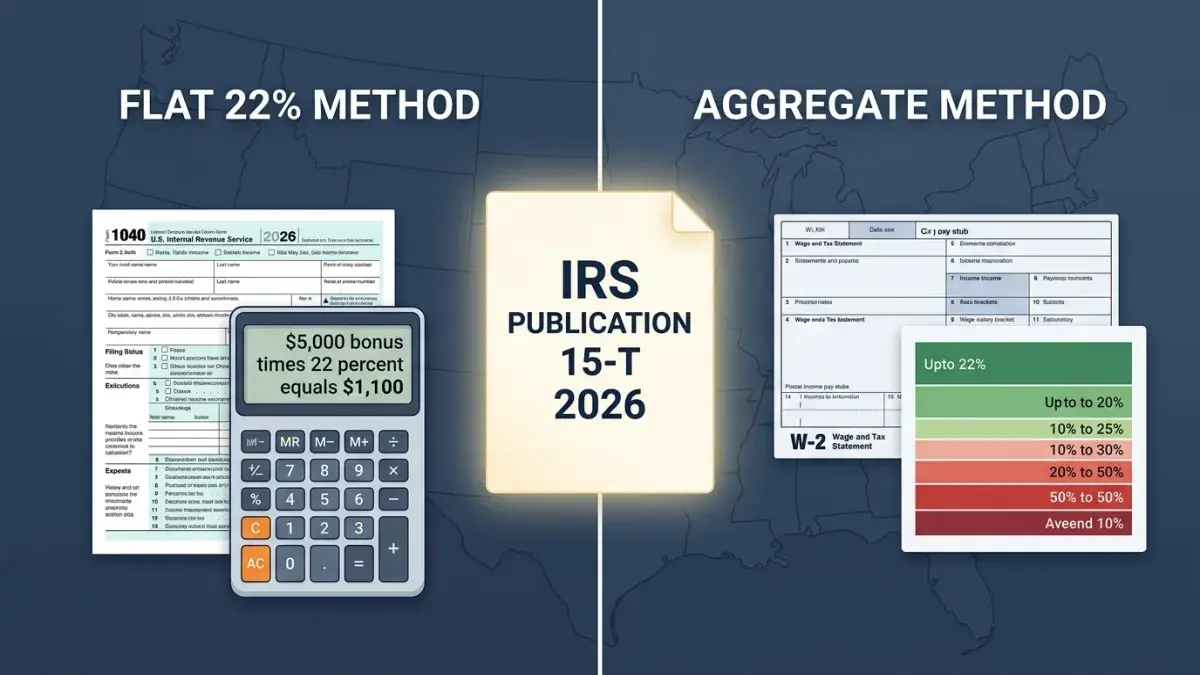
Every December the same question circulates through HR Slack channels and personal-finance subreddits: "Why was 40% of my bonus taken out?" The answer is that the IRS allows employers two different methods to withhold federal tax on supplemental wages, and the choice between them has a real impact on the cash that lands in your account — even though the annual tax liability is identical either way. This piece walks through both methods using the primary source material (IRS Publication 15-T, Federal Income Tax Withholding Methods and IRS Publication 525, Taxable and Nontaxable Income), then runs the numbers across 8 representative states for three bonus sizes.
The goal is operational. By the end you'll be able to predict your take-home on any bonus to within a few percent, know when to ask your employer to switch methods, and understand why a $10,000 bonus check in California nets you $1,000 less than the same bonus in Texas. For the actual side-by-side math at your exact income and state, run the numbers through our bonus tax calculator.
The Two Methods at a Glance
| Method | Federal withholding | When used | Authority |
|---|---|---|---|
| Flat (Percentage) | 22% on first $1M; 37% above $1M | Bonus paid separately from regular wages | Pub 15-T, Section 7 |
| Aggregate | Treats bonus + regular wages as one paycheck, withholds per W-4 tables | Bonus combined with regular wages on one check | Pub 15-T, Section 7 |
The choice between methods is the employer's, not the employee's. Most large payroll providers (ADP, Gusto, Paychex, Workday, Rippling) default to the flat method for separately-issued bonus checks because it is administratively simpler — one multiplication versus a full W-4 recalculation. That default is why the 22% number is the one that circulates publicly even though the aggregate method is just as legal.
The Flat 22% Method, Documented
The flat rate has a specific statutory source. The 22% figure comes from IRS Publication 15-T, Section 7, which sets the supplemental wage withholding rate at the third-lowest income tax rate applicable to single filers — 22% in the 2018-2026 bracket schedule. The 37% mandatory rate on amounts above $1 million is tied to the top marginal bracket. Both rates are set by the Tax Cuts and Jobs Act of 2017 and remain unchanged for 2026.
The mechanics are simple:
- Federal income tax: bonus × 22% (or × 37% on the portion above $1 million cumulative for the year).
- FICA Social Security: bonus × 6.2% up to the 2026 wage base of $176,100 in combined earnings. Above the wage base, 0%.
- FICA Medicare: bonus × 1.45% on every dollar.
- Additional Medicare: bonus × 0.9% on combined wages above $200,000 (single) or $250,000 (MFJ).
- State income tax: per state DOR supplemental wage rate (see table below).
The administrative requirement: under Pub 15-T, the flat method can only be used if (a) the bonus is paid in a separate check from regular wages, or (b) the bonus is identified as a separate line item on a combined check. If neither condition is met, the aggregate method is required.
The Aggregate Method, Documented
The aggregate method is described in the same Pub 15-T Section 7. The employer adds the bonus to the employee's most recent regular wage payment, treats the combined amount as a single pay period, looks up the withholding in the percentage method or wage bracket tables (Pub 15-T Worksheet 1A or 1B), and subtracts the tax already withheld from the regular wages — the remainder is the bonus withholding.
Worked example. A single employee paid $4,000 biweekly (annualized $104,000) has roughly $445 biweekly federal withholding under the 2026 wage bracket tables. A $5,000 bonus added to that paycheck brings the combined gross to $9,000 biweekly, which withholds roughly $1,615. Bonus-only withholding is $1,615 − $445 = $1,170, an effective rate of 23.4% — higher than the flat 22%. The same $5,000 bonus paid to a $1,500-biweekly earner produces only $782 of withholding (15.6% effective), well below the flat 22%.
The crossover. The aggregate method beats the flat method (less withholding, more cash today) when the employee's marginal federal bracket sits below 22%. That breakeven lines up with taxable income of about $47,150 single or $94,300 married filing jointly in the 2026 brackets. For a full deep-dive on this method's mechanics with additional worked examples, see our companion piece on the aggregate vs percentage method tradeoff.
Federal Withholding: Flat vs Aggregate Side-by-Side
The following table holds the bonus constant at $10,000 and varies the employee's annual base salary across five common income tiers. Both methods are computed with federal-only withholding (FICA and state added separately below). Aggregate-method figures use the 2026 wage bracket tables for a single filer, no W-4 adjustments.
| Annual base salary | Marginal bracket | Flat method (22%) | Aggregate method | Difference |
|---|---|---|---|---|
| $35,000 | 12% | $2,200 | $1,540 | Aggregate $660 less |
| $65,000 | 22% | $2,200 | $2,200 | ~$0 (breakeven) |
| $120,000 | 24% | $2,200 | $2,400 | Aggregate $200 more |
| $220,000 | 32% | $2,200 | $3,200 | Aggregate $1,000 more |
| $650,000 | 37% | $2,200 | $3,700 | Aggregate $1,500 more |
Two observations. First, at the $35,000 income level, the flat 22% over-withholds by $660 on a single $10,000 bonus — that money refunds at tax filing but is unavailable to the employee for the months in between. Second, at the $220,000+ level, the flat method under-withholds, which is administratively easier for the employer but can result in an under-payment penalty if total annual withholding is too low against the safe harbor (110% of prior year liability for high earners).
State Supplemental Wage Rates, Sourced
States diverge meaningfully on bonus withholding. Some publish a dedicated supplemental wage rate; some apply their flat state income tax rate; nine have no state income tax at all. The table below shows the 2026 rates published in the state DOR withholding guides, with primary-source citations for the four most-searched states.
| State | Method | Supplemental rate (2026) | Source |
|---|---|---|---|
| California | Flat supplemental | 10.23% (stock options 13.3%) | CA EDD Withholding Schedules |
| New York | Flat supplemental | 11.7% state + 4.25% NYC | NY Pub NYS-50-T-NYS |
| Illinois | Flat state rate | 4.95% (no separate supplemental) | IL DOR Booklet IL-700-T |
| Massachusetts | Flat state rate | 5.0% (9.0% on income above $1M) | MA DOR Circular M |
| Pennsylvania | Flat state rate | 3.07% | PA DOR REV-415 |
| Oregon | Flat supplemental | 8.0% | OR DOR Publication 150-206-643 |
| Texas | No state income tax | 0% | TX Comptroller (no wage tax) |
| Florida | No state income tax | 0% | FL DOR (no wage tax) |
The structural pattern: states with a published flat supplemental rate (CA, NY, GA, IA, ME, MN, NC, OR, VT) treat bonuses like the federal flat method. States with a single flat income tax (IL, IN, MA, MI, PA, UT, KY, CO) apply that same rate to bonuses without a separate calculation. The nine no-income-tax states (TX, FL, NV, TN, WA, SD, WY, AK, NH) only apply federal 22% plus FICA.
Worked Examples: $5K, $15K, $50K Bonus Across 8 States
The following table shows the full take-home for three common bonus sizes across the eight representative states above. Each line assumes the flat federal method (22%), the 2026 state supplemental rate, FICA 6.2% Social Security (wage base assumed not yet hit), and 1.45% Medicare. Single filer, no additional Medicare surtax triggered at the $5K/$15K examples; surtax assumed at the $50K example for a $250K+ base salary.
$5,000 bonus
| State | Federal (22%) | State | FICA (7.65%) | Net take-home | Effective rate |
|---|---|---|---|---|---|
| Texas / Florida | $1,100 | $0 | $383 | $3,517 | 29.7% |
| Pennsylvania | $1,100 | $154 | $383 | $3,364 | 32.7% |
| Illinois | $1,100 | $248 | $383 | $3,270 | 34.6% |
| Massachusetts | $1,100 | $250 | $383 | $3,268 | 34.6% |
| Oregon | $1,100 | $400 | $383 | $3,118 | 37.6% |
| California | $1,100 | $512 | $383 | $3,006 | 39.9% |
| New York (NYC) | $1,100 | $798 | $383 | $2,720 | 45.6% |
$15,000 bonus
| State | Federal (22%) | State | FICA (7.65%) | Net take-home | Effective rate |
|---|---|---|---|---|---|
| Texas / Florida | $3,300 | $0 | $1,148 | $10,553 | 29.7% |
| Pennsylvania | $3,300 | $461 | $1,148 | $10,092 | 32.7% |
| Illinois | $3,300 | $743 | $1,148 | $9,810 | 34.6% |
| Massachusetts | $3,300 | $750 | $1,148 | $9,803 | 34.6% |
| Oregon | $3,300 | $1,200 | $1,148 | $9,353 | 37.6% |
| California | $3,300 | $1,535 | $1,148 | $9,018 | 39.9% |
| New York (NYC) | $3,300 | $2,393 | $1,148 | $8,160 | 45.6% |
$50,000 bonus (high-earner, additional Medicare triggered)
| State | Federal (22%) | State | FICA + 0.9% | Net take-home | Effective rate |
|---|---|---|---|---|---|
| Texas / Florida | $11,000 | $0 | $4,275 | $34,725 | 30.6% |
| Pennsylvania | $11,000 | $1,535 | $4,275 | $33,190 | 33.6% |
| Illinois | $11,000 | $2,475 | $4,275 | $32,250 | 35.5% |
| Massachusetts | $11,000 | $2,500 | $4,275 | $32,225 | 35.6% |
| Oregon | $11,000 | $4,000 | $4,275 | $30,725 | 38.6% |
| California | $11,000 | $5,115 | $4,275 | $29,610 | 40.8% |
| New York (NYC) | $11,000 | $7,975 | $4,275 | $26,750 | 46.5% |
The take-home delta between Texas and NYC on a $50,000 bonus is $7,975 — almost 16% of the gross bonus. This is the same withholding mechanism every employer uses, but the state-tax exposure compounds significantly at higher bonus amounts. For a state-pair comparison of total take-home including base salary, see our cost-of-living and take-home comparison tool; the same state-tax delta that hits bonuses also hits every regular paycheck.
Two Important Wrinkles
NYC, Yonkers, and other local taxes
NYC residents pay an additional 4.25% supplemental rate on top of New York State's 11.7%. Six other US cities tax wage income: Philadelphia (3.75%), Detroit (2.4%), Cleveland (2.5%), Columbus (2.5%), Kansas City (1.0%), plus most Pennsylvania municipalities at a 1% Local Earned Income Tax. The local layer can push all-in bonus withholding above 50% in NYC and above 40% in Philadelphia.
Stock and equity bonuses
RSU vests, ISO exercises, and other equity compensation are also supplemental wages and follow the same 22% / 37% federal framework. State treatment can diverge — California specifically applies 13.3% to stock options versus the 10.23% standard for cash bonuses. For the equity-specific mechanics, see our piece on stock bonus vs cash bonus tax treatment, which covers RSU sell-to-cover defaults and the AMT trigger on ISO exercises.
Decision Matrix: Which Method to Push For
Most employees default into whatever method the payroll system applies and never raise the question. For employees willing to ask payroll to change methods (which is often accommodated when requested in writing before the bonus is cut), the table below maps the decision.
| Your situation | Better method | Cash impact | Tax-filing impact |
|---|---|---|---|
| Marginal bracket 10% or 12% (under $47,150 single) | Aggregate | $300-$700 more cash today on a $10K bonus | Slightly smaller refund (same total liability) |
| Marginal bracket 22% (roughly $47K-$103K single) | Indifferent | Within $50 either way | Within $50 either way |
| Marginal bracket 24% ($103K-$200K single) | Flat 22% | $100-$200 more cash today on a $10K bonus | Slightly larger payment at filing |
| Marginal bracket 32%+ ($200K+ single) | Flat 22% | $1,000+ more cash today on a $10K bonus | Significant payment at filing — set aside reserve |
| Bonus pushes you into a higher bracket | Aggregate | Closer to true liability — fewer surprises at filing | Smaller refund/payment swing |
| Bonus above $1M cumulative for the year | Mandatory 37% flat on amount above $1M | No choice — Pub 15-T mandates 37% above $1M | Aligns closely with top marginal liability |
What People Most Often Get Wrong
Three persistent misconceptions:
- "Bonuses are taxed at a higher rate." They are not. Bonuses are withheld at a different rate than regular wages. Annual liability is identical.
- "The 22% is the actual tax on the bonus." The 22% is a withholding default reconciled at filing — high earners owe more, low earners owe less.
- "My state has no bonus tax." Nine states have no wage income tax (TX, FL, NV, TN, WA, SD, WY, AK, NH), but federal 22% and FICA 7.65% still apply — a 29.7% floor regardless of state.
The Bottom Line
The flat 22% method and the aggregate method are both prescribed in IRS Publication 15-T and produce the same annual tax liability. The flat method is administratively simpler and is the default for most employers. The aggregate method usually produces a withholding that more closely matches the employee's actual marginal rate — better for very low or very high earners who want either more cash today (low earners) or fewer surprises at filing (high earners pushed into higher brackets by the bonus).
State exposure is where the real take-home delta lives. The same $10,000 bonus produces $7,035 of take-home in Texas and $5,440 in NYC under the flat method — a $1,595 gap driven entirely by state and local supplemental rates published in the respective DOR withholding guides. For your specific number with your exact bonus, state, and marginal bracket, use our bonus tax calculator. For the broader context of how a bonus stacks against base salary across states, the parallel cost-of-living analysis at CalcFit's deficit math piece shows how the same "what's the real number" framing applies to nutrition: published headline rates rarely match what reaches the bottom line.
Frequently Asked Questions
Calculate Your Bonus Take-Home
Enter your bonus amount, state, and base salary. Get the exact federal + state + FICA breakdown for both the flat 22% method and the aggregate method side-by-side.