Freelance Day Rate vs Hourly Rate 2026: When to Use Each (with Math)
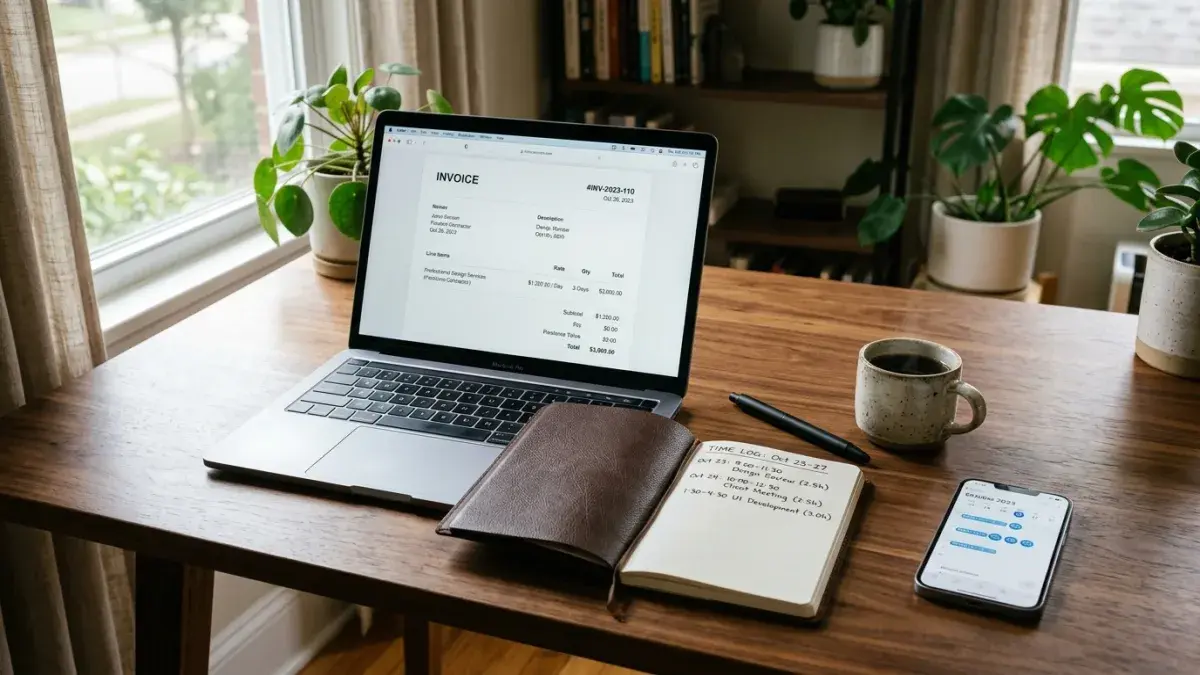
An hourly rate looks like the safe default for new freelancers: track time, multiply by rate, send invoice. But once you have a year of real billing data, the cracks appear — short calls eat administrative time, fragmented hours kill deep work, and clients negotiate every 15-minute increment. A day rate fixes most of that, but only if you know how to set one. This article walks through the conversion math, industry benchmarks for 2026, and the decisions about retainers, taxes, and bundle premiums that determine whether your day rate makes you more or less than your hourly rate.
If you want the underlying minimum-hourly-rate formula first, that math sits in the freelance hourly rate math article. The pillar tool that drives both numbers is the freelance hourly rate calculator.
The Definitions That Matter
Hourly rate. A per-hour fee, billed in 15-, 30-, or 60-minute increments, with a tracked time log shared on the invoice. Common for short engagements, ad-hoc consulting, retainer overflow, and any work where the scope cannot be predicted in advance.
Day rate. A flat fee for a workday of availability. The standard day is 8 hours, but the contract usually defines a day as the working hours between, say, 9 AM and 6 PM local time, with one hour off. The freelancer is paid for the day even if the actual work runs to 6 hours; the client gets first call on those hours even if the work runs to 9.
Project rate. A fixed fee for a defined deliverable, regardless of time spent. Higher risk, higher reward — discussed in our pillar freelance tool.
The Conversion: Hourly to Day Rate
The naive math: $hourly × 8 hours = day rate. The real math: $hourly × 8 × (1 + bundle premium). The bundle premium is the freelancer’s compensation for absorbing schedule risk and idle time on the booked day.
| Hourly rate | Naive day rate (×8) | +10% premium (typical) | +20% premium (high-demand) |
|---|---|---|---|
| $75 | $600 | $660 | $720 |
| $100 | $800 | $880 | $960 |
| $150 | $1,200 | $1,320 | $1,440 |
| $200 | $1,600 | $1,760 | $1,920 |
| $300 | $2,400 | $2,640 | $2,880 |
The 10% premium covers the practical reality that day-rate clients often book and then under-deliver work — you reserve the day, they bring you 6 hours of actual tasks. The 20% premium is appropriate when you are turning down other work to take the booking, or when the client has historically extended day-rate work into evenings or weekends.
2026 Industry Benchmarks
Compiled from the 2024 Bureau of Labor Statistics OES tables, the 2025 Upwork Freelance Forward survey, Toptal’s 2025 talent rate data, and Contently’s 2025 writer-rate benchmark:
| Field | Entry day rate | Mid-career day rate | Senior day rate |
|---|---|---|---|
| Web/software developer | $600-900 | $900-1,400 | $1,400-2,200 |
| UX/product designer | $500-800 | $800-1,200 | $1,200-1,800 |
| Copywriter / content | $400-700 | $700-1,100 | $1,100-1,800 |
| Management consultant | $1,200-2,000 | $2,000-3,200 | $3,200-5,000 |
| Data scientist / ML | $800-1,300 | $1,300-2,000 | $2,000-3,200 |
| Video editor / motion | $400-700 | $700-1,100 | $1,100-1,800 |
| Marketing strategist | $600-1,000 | $1,000-1,600 | $1,600-2,800 |
These ranges describe US- and Western-Europe-based remote freelancers. Adjust upward 15-25% for in-person travel work and downward 10-20% if you are based in a markedly cheaper cost-of-living area and your clients know it (geographic price discrimination is increasingly rejected by US clients in 2026, but it persists with European agencies).
When the Day Rate Wins
A day rate makes more than the equivalent hourly when:
- You are doing deep work. 8 hours of design or engineering produces more value than 8 logged hours with context-switching overhead. Day rates protect deep work because the client cannot interrupt with “quick calls” that would not otherwise be billable.
- The client undervalues short tasks. Hourly clients resist invoices that show 15-minute increments. Day-rate clients pay for the day and stop counting.
- Scope creep is the norm. A day rate caps the daily cost regardless of what surprises emerge — for both sides.
- You are senior enough that the value of your availability exceeds the value of your hours. At consultant rates above $250/hr, the client is buying access more than time.
When the Hourly Rate Wins
Stick with hourly when:
- The work is genuinely fragmented. Call-only consulting, short reviews, retainer overflow.
- Your utilization rate is below 50%. A day rate exposes you to days where you reserved 8 hours and worked 3. Hourly insulates against this.
- The client has unpredictable response times. Day rates assume both parties show up. If the client routinely cancels or no-shows, hourly lets you bill for the time you waited.
The Tax Picture: Identical, but with Cash Flow Differences
Day-rate and hourly income are taxed the same way: Schedule C revenue, Schedule SE self-employment tax (15.3% combined Social Security and Medicare on the first $184,500 of net earnings for 2026; 2.9% Medicare-only above the SS wage base; plus the 0.9% Additional Medicare surtax above $200K single/$250K joint), and ordinary income tax on the net (after the 50% SE-tax deduction and qualified business income deduction where applicable).
See IRS Schedule SE and SE tax basics for the formal rules. The practical cash-flow difference: day-rate freelancers tend to receive income in lumps that map cleanly onto quarterly estimated tax payments, while hourly freelancers receive a more continuous stream that requires monthly internal segregation. Either way, set aside 25-32% of each payment into a separate tax account.
Retainers: The Hybrid Model
A retainer locks in a monthly minimum spend in exchange for a discounted day rate or hourly rate. Typical structure for 2026: $X retainer per month, Y guaranteed days, anything above Y billed at the published day rate.
| Published day rate | Retainer day rate (10 days/mo) | Monthly retainer | Overflow rate |
|---|---|---|---|
| $1,000 | $800 (-20%) | $8,000 | $1,000/day |
| $1,500 | $1,200 (-20%) | $12,000 | $1,500/day |
| $2,000 | $1,700 (-15%) | $17,000 | $2,000/day |
Cap retainer discounts at 25%. Below that, retainers attract clients who want a discount with no commitment.
Working the Math Backwards: Income Goal to Day Rate
The freelance hourly rate calculator takes a target take-home income, desired expenses, tax rate, and billable hours, and outputs a minimum hourly rate. To get a day rate, multiply by 8 and add the bundle premium. For example: a $90,000 take-home target with $15,000 in business expenses, 30% effective tax rate, and 1,200 billable hours yields a minimum hourly rate of about $125/hr → $1,000-1,200/day at typical premiums.
The matching cost-of-living calculator handles the geographic shift if you are moving for the year, and the take-home pay calculator converts a target gross to net for state-by-state planning. If you also train heavy and want to budget the recomp-diet grocery cost into your freelance pricing, the heart rate zones calculator at fit.thicket.sh is a useful cross-reference for matching nutrition and training intensity to the seasonal energy demands of project work.
The Bottom Line
A freelance day rate is not just an hourly rate × 8. It is a bundled product that includes deep-work capacity, availability commitment, and the freelancer’s tolerance for client-side delay. Use day rates for projects that need a focused stretch and clients who can commit a full day. Use hourly for fragmented work, new clients, and any engagement where utilization is uncertain. Tax treatment is identical; cash-flow patterns differ.
Set your number with the freelance hourly rate calculator, then publish both an hourly and a day-rate version on your rate card and let the client choose the unit that fits the work.
Frequently Asked Questions
Set Your Freelance Rate in 60 Seconds
Plug in your target income, expenses, and tax rate. Get the hourly and day-rate numbers that actually pay the bills.