Overtime Pay Rules 2026 — FLSA Federal & State Guide
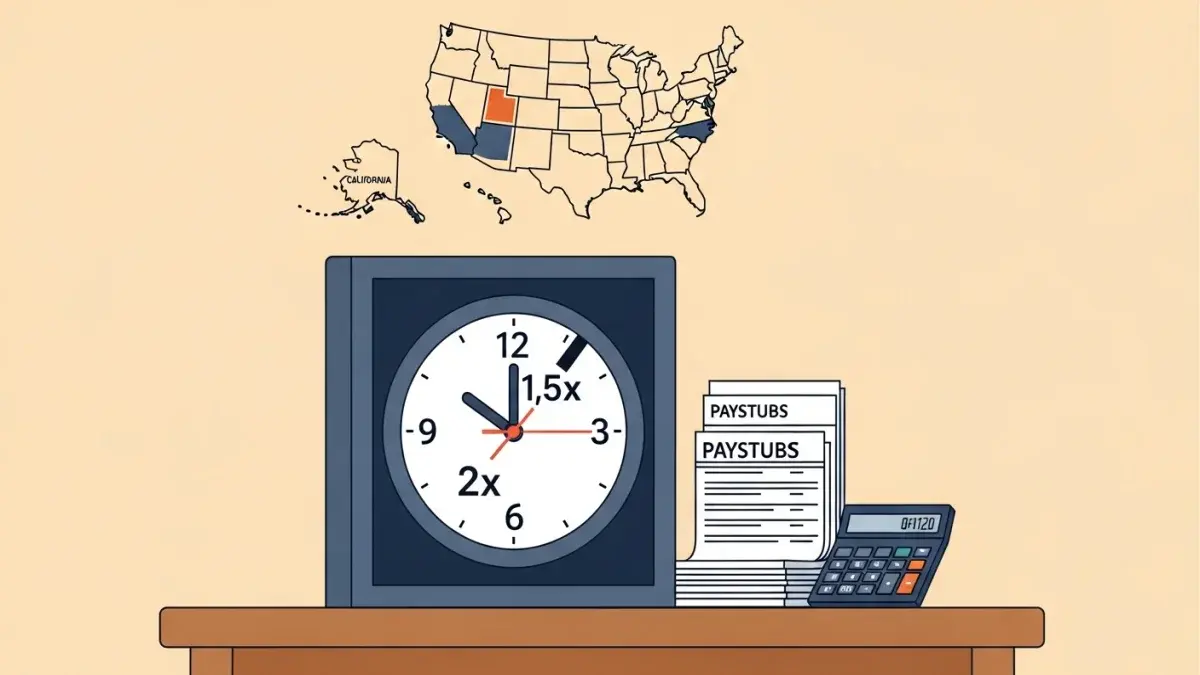
Most American workers think they understand overtime: 1.5x for hours over 40. That is roughly correct under federal law, but it is incomplete enough to cost real money. The 2024 Department of Labor rule raised the salary threshold for exempt status to $58,656, dragging millions of previously-exempt workers back into overtime eligibility. A handful of states require daily overtime triggers that federal law ignores entirely. And the regular-rate calculation for non-exempt salaried workers is a mathematical landmine even HR departments get wrong. Here is what the FLSA actually says, what your state probably adds on top, and the arithmetic you need to verify your own paystub.
The FLSA Federal Floor — What Every State Must Match
The Fair Labor Standards Act of 1938 established the federal overtime regime that still governs most US workers. The rules: any non-exempt employee working more than 40 hours in a single workweek is owed at least 1.5 times their regular rate of pay for the excess hours. Source: U.S. Department of Labor — Overtime Pay.
The workweek is a fixed seven-day period defined by the employer (and not changeable to dodge overtime). Most employers run it Sunday-Saturday, but Monday-Sunday is also common. The 40-hour count is per workweek, not pay period — even on a biweekly schedule, an employee who works 50 hours in week 1 and 30 in week 2 is owed overtime on the 10 hours in week 1, not on average.
Federal law does not require:
- Daily overtime (over 8 hours in a day)
- Weekend or holiday premium pay
- Double time at any threshold
- Premium pay for the seventh consecutive workday
All of those exist only as creations of state labor codes or collective bargaining agreements. Calculate your specific scenario with the overtime pay calculator to see exactly how your hours convert to dollars.
The 2024 DOL Rule — Why $58,656 Matters
Until 2024, the FLSA salary threshold for exempt status was $35,568/year. The Biden DOL raised it in two phases:
- Phase 1 (July 1, 2024): $43,888/year ($844/week)
- Phase 2 (January 1, 2025): $58,656/year ($1,128/week)
- Highly-compensated employee (HCE) threshold: $151,164/year
The phase-2 threshold is the one in effect for all of 2026. Federal courts in Texas struck down portions of the rule in late 2024, and litigation continues — but the $58,656 figure remains the operative DOL standard at the time of writing. Source: 29 CFR Part 541, Final Rule (April 2024).
The practical implication: if you were on a $50,000 salary in a manager-titled role and your employer treated you as exempt, you became eligible for overtime in 2025 — and probably remain eligible in 2026 unless your salary was raised above $58,656.
The Three-Prong Exempt Test
An employee is exempt only if all three conditions are met:
- Salary basis test. Paid a fixed salary that does not vary based on quantity or quality of work in any week worked.
- Salary level test. Salary at or above $58,656/year ($1,128/week).
- Duties test. Primary duties fall into executive, administrative, professional, computer-employee, or outside-sales categories per 29 CFR §541.
The duties test is where most misclassification happens. An "Operations Manager" who actually spends 80% of her time doing the same data-entry work as her team is not exempt — regardless of title or salary. The DOL Wage and Hour Division (WHD) recovers more than $200 million in back wages from employers each year, much of it from misclassification.
State-by-State Daily Overtime Rules
Daily overtime is a state-only construct. The states that require it:
| State | Daily 1.5x trigger | Daily 2x (double time) | 7th consecutive day rule |
|---|---|---|---|
| California | Over 8 hrs/day | Over 12 hrs/day | 1.5x first 8, 2x after 8 |
| Alaska | Over 8 hrs/day | None | None |
| Colorado | Over 12 hrs/day OR 12 consecutive hrs | None | None |
| Nevada (employees under 1.5x state min wage) | Over 8 hrs/day | None | None |
| All other states | None federal default | None | None |
California's rule is the most lucrative for workers. A California non-exempt employee earning $30/hour who works 14 hours in a single day is owed:
- First 8 hours at $30 = $240 (regular)
- Hours 9-12 at $45 (1.5x) = $180 (daily OT)
- Hours 13-14 at $60 (2x) = $120 (double time)
- Total: $540 for 14 hours = effective $38.57/hr
In Texas (federal default), the same 14-hour day in week of 40 total hours = $30 × 14 = $420 — no daily OT trigger, just standard hourly pay until the 40-hour weekly threshold. The same shift, in a different state, pays 28% more. Source: California DIR Overtime Exemptions FAQ.
State-specific take-home math gets even more interesting once tax differences compound. The state-by-state take-home pay analysis shows the after-tax dollar gap.
The Regular Rate — Where Most Employers Mess Up
The "regular rate" is the divisor used to compute overtime. It is not always the hourly rate on your offer letter. Per 29 CFR §778.108, the regular rate must include almost all forms of compensation: base hourly wage, non-discretionary bonuses, shift differentials, on-call premiums, and commissions earned in that workweek.
Example: an hourly employee earning $25/hr base, working 50 hours, who also earned a $200 production bonus that week:
- Total straight-time pay: $25 × 50 = $1,250
- Plus bonus: +$200
- Total weekly compensation pre-OT: $1,450
- Regular rate: $1,450 ÷ 50 = $29.00/hr
- OT premium owed (the 0.5x half-time): $29 × 0.5 × 10 OT hours = $145
- Final paycheck: $1,250 + $200 + $145 = $1,595
Many employers compute overtime as $25 × 1.5 × 10 = $375 and pay $1,250 + $200 + $375 = $1,825 — over-paying. Others compute $25 × 0.5 × 10 = $125 — under-paying by $20. The correct method is the bonus-inclusive regular rate. The under-payment version is a classic FLSA violation.
How Overtime Is Taxed
The biggest myth in payroll: "overtime is taxed higher." It is not. The IRS treats overtime as ordinary wages. Federal income tax, FICA (6.2% Social Security + 1.45% Medicare), and any state income tax all apply at the same rate as regular pay.
What changes is withholding. IRS Publication 15-T uses two methods that can over-withhold on a paycheck with overtime:
- Percentage method: the employer annualizes the paycheck (multiplies by pay periods) to determine the withholding bracket. A spike that doesn't recur all year over-withholds.
- Aggregate method: bonus-style supplemental wages are withheld at 22% federal flat (regardless of your actual marginal rate).
You recover the over-withheld amount on your tax return — it's not lost, just delayed. Run your specific numbers in the take-home calculator to see the actual federal/state/FICA breakdown. For 2026, the FICA wage base rises to $176,100 (per the SSA's 2026 Contribution and Benefit Base table at ssa.gov/oact/cola/cbb.html), so high earners stop accruing the 6.2% Social Security tax above that threshold.
What Counts as "Hours Worked"
The 29 CFR §785 regulations define compensable time in detail. The key rules:
- Short rest breaks (under 20 min) are paid. Coffee breaks, smoke breaks, restroom breaks count toward the 40-hour threshold.
- Meal breaks (30+ min) are unpaid if the employee is fully relieved of duty. If the employee answers calls or covers a station during lunch, it is paid.
- On-call time is paid if the employee must remain on premises or so close that personal use of the time is impractical. Free-roaming on-call (you can be home, just need to respond to a call) is usually unpaid.
- Travel between job sites during a shift is paid. Home-to-first-site and last-site-to-home commute is unpaid.
- Required training and meetings are paid. Even if scheduled outside normal hours.
- Employer-required remote work hours (after-hours emails, weekend Slack obligations) are paid for non-exempt workers.
- Donning/doffing specialized PPE (firefighter gear, meat-packing protective equipment) is paid per IBP v. Alvarez (2005, US Supreme Court).
For non-exempt remote workers, the off-the-clock email problem is real. If your employer expects responses outside scheduled hours, log the time — and demand pay for it. Class actions on this exact issue have settled for tens of millions.
How to Calculate Your Own Overtime
The five-step verification process for any pay period:
- Confirm exempt status. Salary >= $58,656 AND duties qualify? You're exempt — no overtime owed. Otherwise, you're non-exempt.
- Identify your workweek. Check the employee handbook or HR system. Hours worked Mon-Sun? Sun-Sat? It matters.
- Sum hours worked in the workweek. Include compensable categories from above.
- Calculate regular rate. Total straight-time wages + non-discretionary bonuses ÷ total hours worked.
- Apply OT multiplier. 1.5x regular rate × hours over 40 (federal); apply state daily OT and double-time rules layered on top.
Run this in the overtime pay calculator for the basic federal version, then cross-check daily-OT states manually. For broader take-home math after tax, the take-home pay calculator handles the federal/state/FICA breakdown.
If You Believe You're Owed Overtime
The federal statute of limitations for FLSA wage claims is two years (three for willful violations). The DOL Wage and Hour Division accepts complaints free of charge. Most claims succeed at the pre-litigation back-wage stage; some require federal court action. Liquidated (double) damages are available for willful violations. Employer retaliation against an employee filing an FLSA complaint is itself a separate violation, with reinstatement and lost-wage remedies.
State labor commissioners (especially the California Labor Commissioner) often resolve cases faster than federal channels. Check both. The combination of federal recovery + California state penalties has produced multi-million-dollar settlements for misclassified tech and finance workers in recent years.
The Trade-offs of Overtime Work
Even if every dollar is correctly paid, overtime creates trade-offs worth modeling. A non-exempt worker grinding 60-hour weeks at 1.5x is earning 50% more total pay for 50% more time — roughly a 0% productivity premium per hour worked. The marginal tax bracket may push you into higher rates. Health and family costs are real. Use the salary calculator to compare your effective hourly rate at 40, 50, and 60 hours per week. The cleanest answer is often: negotiate a higher base rate, not more hours.
And if grocery and rent costs are the reason you're stacking overtime, the life expectancy calculator at age.thicket.sh has an unfortunately relevant input: chronic overwork is associated with cardiovascular and mortality risks worth modeling alongside the income gain.
Sources and Methodology
FLSA overtime rules: U.S. Department of Labor Wage and Hour Division. 2024 final rule on exempt salary thresholds: 29 CFR Part 541 (Federal Register, April 2024). California overtime rules: California Division of Labor Standards Enforcement. FICA wage base 2026: SSA Contribution and Benefit Base. Compensable time regulations: 29 CFR §785; IBP v. Alvarez, 546 U.S. 21 (2005).
All calculations verified against IRS Publication 15-T 2026 and DOL WHD Field Operations Handbook. Last updated May 2, 2026.
Frequently Asked Questions
Calculate Your Overtime Pay Now
Plug in your hourly rate, regular hours, and OT hours to see exact federal time-and-a-half and double-time totals.
Open Overtime Calculator →