Paycheck Withholding: When to Update Your W-4 in 2026 (The Complete Trigger List)
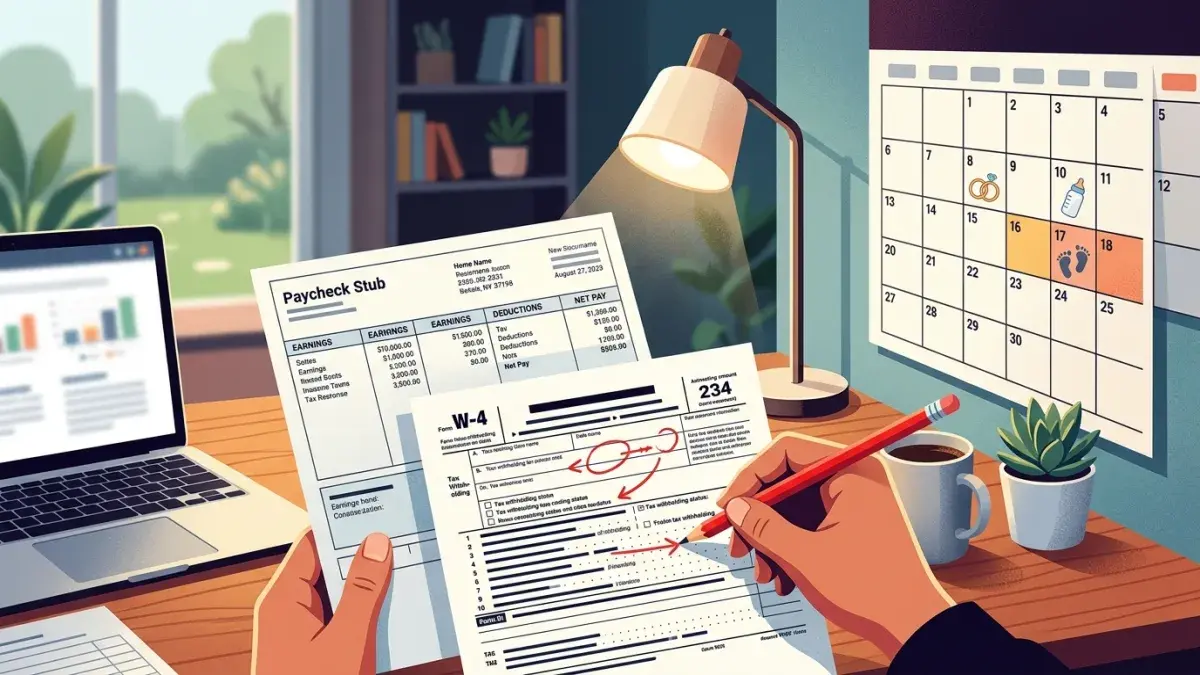
The W-4 is the most consequential one-page form in American employment. It determines how much federal income tax comes out of every paycheck — directly shaping your take-home pay, April refund or bill, and exposure to IRS underpayment penalties. The 2025 and 2026 tax law updates (expanded brackets, higher standard deduction, SECURE 2.0 changes) mean millions of workers have a stale W-4 that is over- or under-withholding by hundreds of dollars. Here is when to fix it.
The Ten Events That Demand a New W-4
The IRS Publication 505 recommends updating your W-4 within 10 days of any event that changes your tax liability by more than about 10%. These are the triggers, in rough order of frequency:
- Marriage or divorce. Filing status changes your brackets and standard deduction.
- Birth or adoption of a child. Adds a $2,000 Child Tax Credit (under 17) or $500 credit for other dependents.
- A child aging out. Loses the Child Tax Credit the year they turn 17.
- Second job or spouse starting work. Pushes household income into higher brackets; requires Step 2 adjustment.
- Side income or freelance work. Needs Step 4(c) additional withholding or quarterly estimates.
- Promotion, bonus structure change, or salary increase above 10%. Pushes you into a new bracket.
- Home purchase with significant mortgage interest. May shift you to itemized deductions worth Step 4(b) adjustment.
- Pension, Social Security, or retirement distribution start. Adds income not withheld by default.
- Moving to a different state. May require a new state W-4 (state form) even if the federal stays the same.
- Tax law change (like the expired 2025 TCJA provisions). Brackets, standard deduction, and credits shift.
Life event triggers come from IRS Publication 505 (Tax Withholding and Estimated Tax).
The Five Steps of the Current W-4 (2020 Redesign)
The W-4 was redesigned for 2020 and remains unchanged in structure for 2026. It no longer uses allowances. Here is what each step does.
Step 1: Personal Information
Name, address, SSN, filing status. Choose Single/Married filing separately, Married filing jointly/Qualifying widow(er), or Head of household. The default if you skip: single.
Step 2: Multiple Jobs or Spouse Works
This is the most commonly botched step in dual-income households. You have three options:
- Option a: Use the IRS withholding estimator at irs.gov/individuals/tax-withholding-estimator. Most accurate.
- Option b: Use the Multiple Jobs Worksheet on page 3 of the W-4 to calculate extra withholding.
- Option c: Check the box on Step 2(c) if both jobs pay about the same. Simple but only works when incomes are within 10% of each other.
Skipping this step is why so many dual-earner couples owe taxes in April. Each employer assumes it is your only job and withholds at the low end of the brackets.
Step 3: Claim Dependents
Multiply qualifying children under 17 by $2,000. Multiply other dependents by $500. Enter the total. For 2026 the Child Tax Credit phases out at $200,000 single / $400,000 joint. Enter $0 in Step 3 if you are above that threshold.
Step 4: Other Adjustments (Optional)
- 4(a) Other income: Enter dividends, interest, or side income you want withheld from this paycheck. Common for workers who have significant investment income.
- 4(b) Deductions: If you expect to itemize (mortgage interest, charitable giving, medical > 7.5% AGI, SALT up to $10,000), enter the amount above the standard deduction ($16,100 single / $32,200 joint in 2026).
- 4(c) Extra withholding: A dollar amount you want added to each paycheck. Quickest way to cover side income or a predictable tax gap.
Step 5: Sign and Date
The form is not valid without your signature. Your employer updates withholding in the next payroll cycle after receipt (usually within 15 days).
The Safe Harbor Rule: How to Avoid Underpayment Penalties
The IRS charges an underpayment penalty if you owe more than $1,000 at filing and you withheld less than the safe harbor threshold. For 2026 the safe harbor is:
- 90% of current-year tax liability, or
- 100% of last year’s tax liability (110% if your prior-year AGI exceeded $150,000).
The 100% prior-year rule is the easiest benchmark: just withhold what you paid last year. Your 2025 Form 1040 Line 24 is the number to beat. The 2026 underpayment penalty rate is set quarterly by the IRS — it hit 8% in 2025 and is projected to remain near 7-8% in 2026.
Warning Signs Your W-4 Is Wrong
Sign 1: Last Year’s Refund Was Over $2,000
A refund means you overwithheld. $2,000 is $77 per biweekly paycheck the IRS held for free instead of you earning interest or paying down debt. That $77 in a money market account at 5% for a year is $39 in lost interest. Over a career, optimizing your W-4 can be worth $5,000-$10,000 in forgone returns.
Sign 2: You Owed More Than $1,000 in April
You are in underpayment territory. Even without a penalty, writing a four-figure check in April is poor cash flow planning. Adjust Step 4(c) to add additional withholding spread across the remaining paychecks.
Sign 3: Your Paycheck Suddenly Got Bigger or Smaller
Employers update withholding tables each January when the IRS releases new brackets (IRS Publication 15-T). A sudden $50 swing in your paycheck in January typically means bracket adjustment, not an error — but confirm with the take-home calculator.
Sign 4: You Changed Jobs Mid-Year
Your new employer treats you as a full-year employee making your new salary. If you started July 1 at $100,000, they withhold as if you earn $100,000 the full year. But your actual 2026 W-2 will show combined earnings from both jobs — often less than projected, so you overwithhold. Or if you changed to a higher-paying job, the new employer may underwithhold because they are not aware of prior-employer wages counted against Social Security’s $184,500 cap.
The Dual-Income Couple Playbook
Dual-earner couples are the most likely to get withholding wrong. The easiest approach for 2026:
- Both spouses file W-4s with filing status Married filing jointly.
- The higher earner completes Steps 2, 3, and 4. The lower earner leaves them blank.
- Higher earner uses the IRS estimator (irs.gov/individuals/tax-withholding-estimator) to figure total household withholding.
- Enter additional withholding on the higher earner’s Step 4(c) rather than splitting it.
- Check results after first full paycheck using the take-home pay calculator.
See our guide on how HSA and FSA coordination further reduces W-4 complexity by shrinking taxable income for both spouses.
State W-4: Do Not Forget It
Your federal W-4 does not update state withholding. Most states have their own form (CA DE-4, NY IT-2104, etc.). After a life event, check your state-specific form too. Some states allow a simple “same as federal” checkbox; others require separate calculations. Our state-by-state take-home pay guide lists the forms by state.
When NOT to Update Your W-4
- A small bonus. Supplemental withholding is flat 22% — updating W-4 does not help.
- A 2-3% raise. Barely moves your bracket. Annual reviews will catch it.
- Short-term stock vesting. RSUs usually withhold at 22% supplemental; Step 4(c) might overcorrect.
- After receiving a refund. Wait until the next life event or January baseline review.
How to File a New W-4 in 2026
Get the form at irs.gov/forms-pubs/about-form-w-4 or ask your HR portal. Most companies use electronic self-service via ADP, Workday, Paycom, or Gusto. Changes take effect the next pay period. Verify the change on your first stub — look for “Filing Status” and “Extra W/H” fields. If the numbers did not change, contact payroll.
Side Income: W-4 vs Quarterly Estimates
If you have a steady paycheck plus regular side income (Uber, Etsy, consulting), two valid approaches exist:
- W-4 Step 4(c): Ask your employer to withhold extra from your main paycheck. Simple, one form, no quarterly paperwork.
- Quarterly estimates (Form 1040-ES): Pay the IRS directly four times a year. More flexible if side income is irregular.
Our guide on side-hustle quarterly estimated taxes covers the tradeoffs and the four 2026 deadlines in detail.
When the IRS Sends a “Lock-In Letter”
If the IRS determines your W-4 is inaccurate enough that you are chronically underwithholding, it can send your employer a Letter 2800C that mandates specific withholding. This overrides your W-4 and cannot be reversed without IRS approval (Form 9465 or direct contact). Lock-ins are rare but real — they are usually triggered by multiple years of unpaid underwithholding balances.
Quick Checklist for 2026
- [ ] Review last year’s refund or balance due amount.
- [ ] Note any life events from January 2026 to today.
- [ ] Use the IRS estimator to project 2026 liability.
- [ ] Check both federal W-4 and state withholding form.
- [ ] If married, coordinate with your spouse on Step 2.
- [ ] Submit new W-4 to HR; verify on next paycheck stub.
- [ ] Recheck at mid-year (July) if you had a promotion, bonus, or job change.
Last verified: April 20, 2026. Sources: IRS Form W-4 (2026), IRS Publication 505, IRS Publication 15-T (Employer’s Withholding Tables), and IRS Withholding Estimator.
Frequently Asked Questions
Check Your Withholding vs. Actual Liability
Run your 2026 scenario through the take-home calculator. Compare projected withholding to tax due to confirm your W-4 is right.
Open Take-Home Calculator →