Biweekly vs Semi-Monthly Pay: Differences, Pros, and Which Is Better
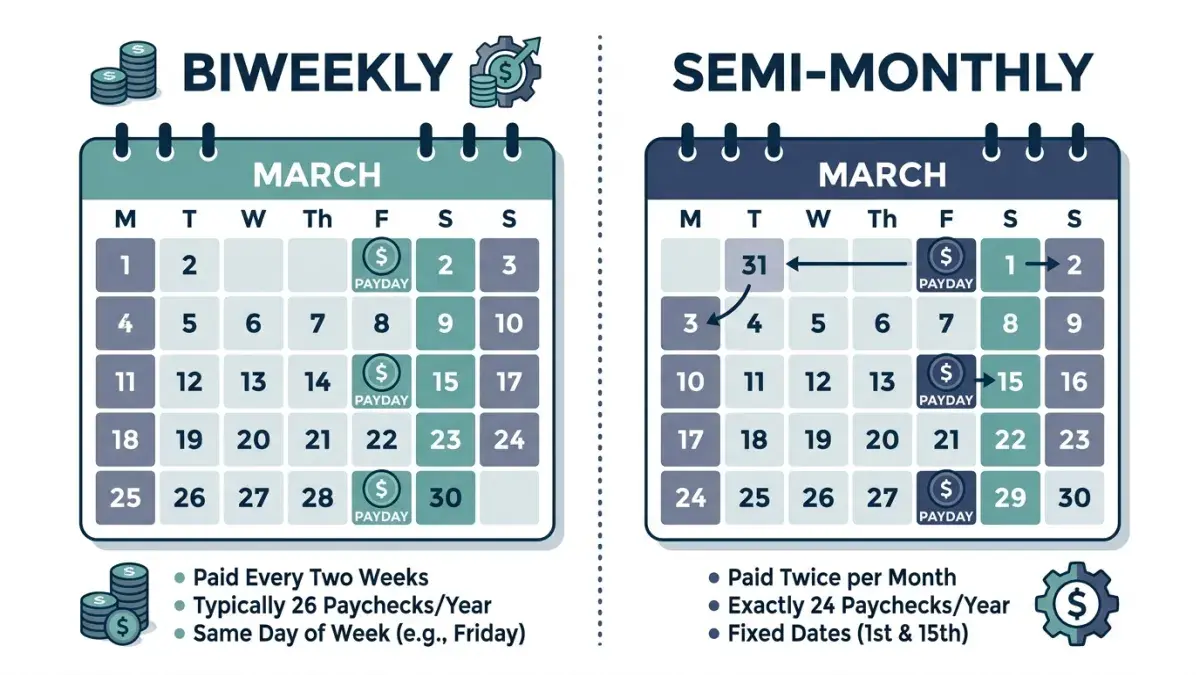
Biweekly pay means 26 paychecks a year (one every two weeks); semi-monthly pay means 24 paychecks a year (twice a month on set dates such as the 1st and 15th). They deliver the same annual salary, but they differ in paycheck size, the weekday your money arrives, how overtime is calculated, and how well payday lines up with your bills. Here is the full comparison so you can tell which one you have — and which one is actually better for your situation.
The Core Difference: Every 14 Days vs. Twice a Month
The two schedules sound similar but count time in completely different ways:
- Biweekly pays every 14 days regardless of the calendar month. Because 52 weeks ÷ 2 = 26, you get 26 paychecks in a normal year. Paydays drift across the month and always land on the same weekday (say, every other Friday).
- Semi-monthly pays twice per calendar month on two fixed dates — commonly the 1st and 15th, or the 15th and the last day of the month. That is 2 × 12 = exactly 24 paychecks a year, every year. Paydays land on the same calendar dates but shift across weekdays (and often move to the prior business day when the date falls on a weekend).
This 14-day-vs-twice-a-month distinction is why biweekly occasionally produces a 27th paycheck in certain years, while semi-monthly is locked at 24 forever.
Side-by-Side Comparison
| Feature | Biweekly | Semi-Monthly |
|---|---|---|
| Payment interval | Every 14 days | Twice a month (fixed dates) |
| Paychecks per year | 26 (occasionally 27) | Exactly 24 |
| Per check on $60,000 | $2,308 | $2,500 |
| Per check on $100,000 | $3,846 | $4,167 |
| Payday falls on | Same weekday, shifting dates | Same dates, shifting weekday |
| “Three-payday” months | Yes — two per year | Never |
| Overtime alignment | Clean (matches 7-day workweek) | Awkward (period crosses workweeks) |
| Aligns with rent/bills due 1st & 15th | No | Yes |
| Most common in | Hourly, retail, tech, union | Salaried finance, professional services |
Paycheck Size: Why Biweekly Checks Are ~8% Smaller
Because biweekly divides your salary by 26 and semi-monthly divides it by 24, each biweekly check is smaller — but you receive two more of them per year. On a $100,000 salary:
- Biweekly: $100,000 ÷ 26 = $3,846 gross per check
- Semi-monthly: $100,000 ÷ 24 = $4,167 gross per check
The semi-monthly check is about 8.3% larger, but that is not extra money — it is the same annual pay concentrated into fewer, bigger deposits. To see your exact per-check take-home on either schedule, run your number through the salary calculator and toggle the pay frequency.
Budgeting Impact: The Real Reason People Care
The practical difference is cash-flow rhythm, and it cuts both ways:
Biweekly: two “extra” paychecks feel like a bonus
Two months each year contain three biweekly paydays instead of two. If you budget your fixed monthly bills against just two checks, those two “third paychecks” become de facto windfalls — a favorite tactic is to earmark them for savings, an IRA contribution, or debt payoff. The trade-off is that paydays drift, so a bill due on the 1st is not always freshly funded.
Semi-monthly: perfectly predictable dates
With paydays fixed on the 1st and 15th, your income lines up with the two moments most bills are due — rent/mortgage on the 1st, credit cards and utilities mid-month. There are no surprise third checks, which makes month-to-month budgeting simpler but removes the “bonus paycheck” effect. If your rent is due the 1st and you are paid semi-monthly, that check is reliably there.
Overtime: Where Biweekly Has a Real Advantage
Federal overtime under the Fair Labor Standards Act is calculated on a fixed 7-day workweek. A biweekly period is exactly two workweeks, so overtime math is clean. A semi-monthly period does not align with the workweek — a single pay period can start mid-week and cut a workweek in half, forcing payroll to track hours across period boundaries. That is a major reason hourly and non-exempt roles skew heavily biweekly. If overtime is part of your pay, see how the regular-rate math works in our overtime pay calculator.
Which Employers Use Which?
Biweekly is the single most common pay frequency in U.S. private industry. According to the U.S. Bureau of Labor Statistics, biweekly is the most common length of pay period among private establishments, ahead of weekly, semi-monthly, and monthly — and biweekly use rises as establishment size increases. Weekly pay dominates in industries like construction, while semi-monthly is concentrated among salaried professionals in finance, real estate, and other white-collar fields whose bills track the calendar month. BLS tracks these pay-period lengths in its Current Employment Statistics program.
Pros and Cons at a Glance
| Biweekly | Semi-Monthly | |
|---|---|---|
| Pros | Two bonus-feeling paychecks a year; clean overtime; consistent weekday deposits | Larger checks; paydays match the 1st/15th bill cycle; only 24 payroll runs to process |
| Cons | Paydays drift across the month; occasional 27-check year complicates withholding and 401(k) caps | Overtime math is awkward across periods; no windfall checks; a payday can slip to a Friday-before when the date is a weekend |
So Which Is Better?
There is no universal winner because your annual pay is identical either way. Pick based on how you live:
- Choose biweekly if you work hourly or earn overtime, or if you like the forced-savings effect of two “extra” checks a year.
- Choose semi-monthly if you are salaried and want larger, perfectly date-predictable checks that line up with rent and bills on the 1st and 15th.
In practice, most people do not choose — the employer sets the schedule, often constrained by state law. Employers can switch frequencies but must satisfy minimum-frequency rules under the U.S. Department of Labor state payday requirements, which vary by state. Whatever schedule you land on, the annual math is the same — confirm your exact take-home with the take-home pay calculator.
Sources and Methodology
Pay-frequency prevalence: U.S. Bureau of Labor Statistics, “How frequently do private businesses pay workers?” and BLS Current Employment Statistics: Length of pay periods. Pay-frequency law: U.S. Department of Labor, State Payday Requirements. Withholding-per-period methodology: IRS Publication 15-T. Per-check figures computed as annual salary ÷ 26 (biweekly) and ÷ 24 (semi-monthly). Last updated July 4, 2026.
Frequently Asked Questions
See Your Paycheck on Either Schedule
Convert your annual salary into exact biweekly, semi-monthly, weekly, and monthly take-home pay. Toggle the pay frequency to compare check sizes side by side.
Open Salary Calculator →