Cost of Living Index Sources Compared: C2ER vs BLS vs Numbeo (2026)
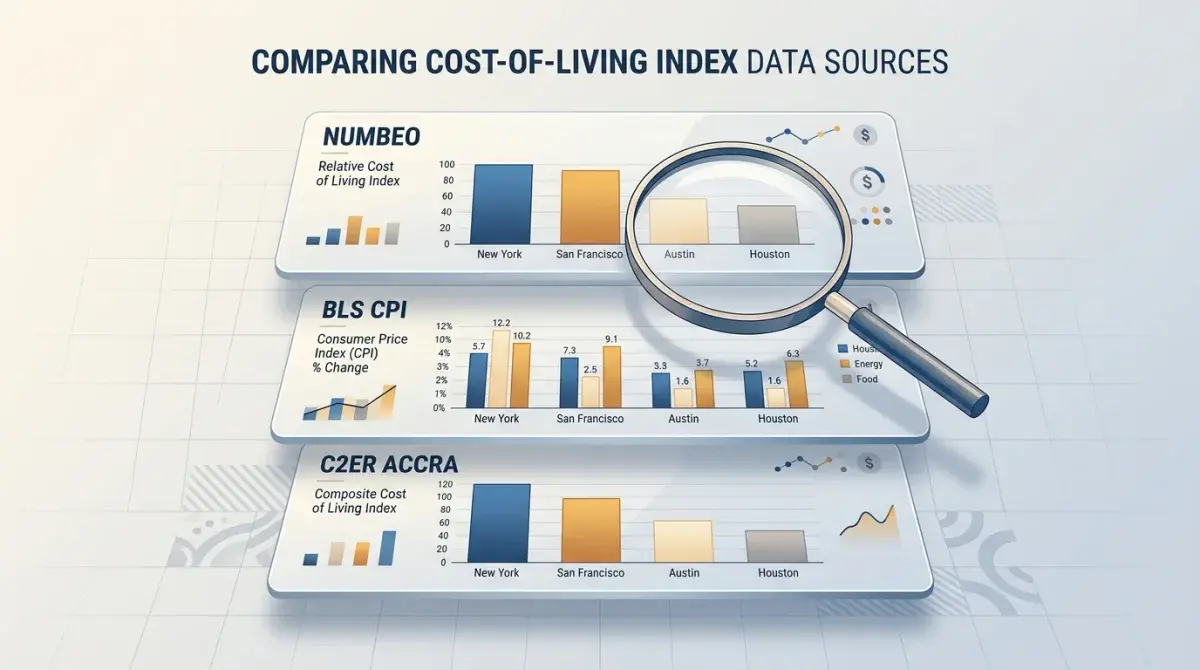
Type "cost of living comparison" into any search engine and the top results disagree with each other. BestPlaces says San Francisco is 80% more expensive than Houston. Numbeo says 64%. Bankrate says 76%. The published numbers diverge not because anyone is wrong, but because they're computed from three different basket designs, three different geographic definitions, and three different update cadences. If you don't know which index you're reading, you don't know what the number means.
This piece walks through the four data sources that drive almost every cost-of-living comparison published in the US — C2ER ACCRA, BLS Regional CPI, Numbeo, and the licensed wrappers (BestPlaces, Bankrate, Sperling's) — and shows when each one is the right tool. The goal is operational: by the end of this article you'll know which index to anchor on for a 2026 relocation decision, which one to use as a cross-check, and which one to ignore.
The Four Sources at a Glance
| Source | What it measures | Geography | Cadence | 2026 strength |
|---|---|---|---|---|
| C2ER ACCRA | Composite index, 60-item basket | ~270 MSAs | Quarterly | Best US metro-to-metro |
| BLS Regional CPI | Inflation rate (change, not level) | 4 regions + 23 metros | Monthly | Official inflation source |
| Numbeo | Crowdsourced composite + sub-categories | Global, 11,000+ cities | Continuous rolling 12-month | International + thin-data cities |
| BestPlaces / Bankrate | Licensed C2ER data, salary-equivalent UI | ~270 MSAs (C2ER coverage) | Quarterly (30-60 day lag) | Free consumer-facing tool |
The rule of thumb: every reputable free US cost-of-living tool you'll find online is ultimately a wrapper over C2ER ACCRA data, BLS Regional CPI, or a blend. Knowing which underlying source the tool uses tells you what its strengths and blind spots are. For the full 30-metro composite ranking and sub-index decomposition we ship at PayScale Pro, see our 2026 ranking of 30 US cities by cost of living.
C2ER ACCRA: The Domestic Gold Standard
The Council for Community and Economic Research (C2ER) publishes the ACCRA Cost of Living Index, which has been the reference series for US metro-to-metro comparisons since 1968. The mechanics matter, because they explain why C2ER outperforms Numbeo and BLS for relocation decisions:
- Trained price-takers. Each participating metro fields volunteers — usually local chamber-of-commerce staff or university researchers — who physically visit retailers and record prices on a standardized basket. This eliminates the self-selection bias that crowdsourcing introduces.
- 60-item fixed basket. Same brands, same package sizes, same item count in every metro. The basket includes specifics like "Heinz ketchup, 32 oz" and "T-bone steak, USDA Choice, per pound" — not a generic "ketchup price" category. Like-for-like comparison is enforced at the line-item level.
- Quarterly publication. Q1 data lands in late May, Q2 in late August, Q3 in late November, Q4 in late February. A relocation decision made in May 2026 should use the Q1 2026 data, not Q4 2025.
- 270 metros covered. This is the largest coverage of any US metro-level cost-of-living index. Every metro with at least 50,000 population has at least episodic coverage; the top 100 metros have continuous quarterly data.
- Six-sub-index decomposition. Housing (28%), miscellaneous goods and services (35%), groceries (13%), utilities (10%), transportation (10%), healthcare (4%).
The known limitations: C2ER reports at the metro statistical area level, which inflates suburb-rich metros and deflates dense urban cores. The Manhattan-only index would be roughly 30 points higher than the New York MSA composite of 187. C2ER also does not include state or local income tax, which can move the real comparison by 10-15% on top of the consumer-price differential.
For an example of the C2ER composite at work in a single city pair: our New York vs Austin cost of living comparison uses the same C2ER decomposition to show that the 37% headline gap is driven almost entirely by housing (NY 232 vs Austin 138), with miscellaneous services accounting for most of the remainder.
BLS Regional CPI: The Inflation Source That People Misuse
The Bureau of Labor Statistics publishes Consumer Price Index data monthly for the US as a whole, four regions (Northeast, Midwest, South, West), and 23 metropolitan areas. The misconception is that BLS CPI lets you compare cost of living between cities. It does not. BLS itself explicitly states that CPI is designed to measure price change over time within a single area, not price level between areas.
What BLS CPI actually does well:
- Official inflation rate. If you're calculating a cost-of-living-adjustment (COLA) clause in an employment contract, lease, or alimony agreement, BLS CPI is the legally defensible source. The annual CPI-U figure is the one most contracts reference.
- Regional inflation differentials. The four regional CPIs let you see whether the Northeast is inflating faster or slower than the West in any given month. This is useful for macro-level wage planning but not for city-to-city level comparison.
- Item-level decomposition. BLS publishes CPI sub-indexes for food, energy, shelter, medical care, transportation, and dozens of more granular categories. This is the right source for understanding which expense categories are driving inflation in your region.
The basket weighting in BLS CPI comes from the Consumer Expenditure Survey, which is methodologically distinct from the C2ER basket. BLS gives shelter ~33% weight versus C2ER's 28% housing weight — a difference that pushes BLS-based comparisons to look 5-10% more sensitive to housing costs than C2ER-based comparisons.
The right way to use BLS data in a relocation decision: do the level comparison with C2ER, then sanity-check the trend with BLS Regional CPI to make sure neither metro is in the middle of an unusual inflation episode that would change the picture six months later.
Numbeo: Useful Where C2ER Doesn't Reach
Numbeo is a crowdsourced cost-of-living database with 11,000+ cities globally. Users submit prices for a standardized list of items — rent for a one-bedroom in the city center, a Coca-Cola in a restaurant, a 1 kg of chicken breasts — and Numbeo aggregates them into composite indexes, sub-category indexes, and city pair comparisons.
The strengths:
- International coverage. Numbeo is the only widely-used source with consistent methodology across the US, Europe, Latin America, and Asia. For a US-to-international comparison (NYC to Lisbon, SF to Mexico City, Austin to Berlin) Numbeo is the only practical tool.
- Thin-data US cities. For US cities under 250,000 population that fall outside C2ER's continuous coverage, Numbeo often has at least some data when C2ER has none.
- Granular sub-categories. Numbeo breaks out restaurant meals (inexpensive vs mid-range), supermarket items by line, transportation (gas, monthly pass, taxi), utilities, sports/leisure, childcare, and rent by bedroom count and neighborhood tier. The granularity exceeds C2ER's 60-item basket.
The weaknesses:
- Sample-size volatility. Numbeo's accuracy is a function of how many users have submitted prices recently. For large US metros (top 50 by population) the sample is healthy and the numbers track C2ER within 5-8%. For metros 100-300 in size, the gap widens to 10-15%. For metros under 100,000 the data can be 20%+ off and should not be used.
- Self-selection bias. Numbeo contributors tend to be expats, students, and digital nomads — younger and more urban than the general population. This skews the basket toward urban-center restaurant prices and away from suburban grocery prices.
- No official audit. Numbeo has lightweight quality filters but no equivalent of C2ER's trained price-takers. Outlier entries are smoothed but not eliminated.
Practical rule: use Numbeo for international comparisons and as a cross-check for top-30 US metros. Don't anchor a relocation decision on Numbeo alone for any US city.
BestPlaces, Bankrate, NerdWallet: The Licensed Wrappers
The most widely-used free US cost-of-living tools — BestPlaces (Sperling's), Bankrate's calculator, NerdWallet's calculator, PayScale's salary calculator — are all licensed users of C2ER ACCRA data. They wrap the same underlying numbers in different UIs and add different overlays: BestPlaces adds neighborhood-level data, Bankrate adds a salary-equivalent calculator, NerdWallet adds a budget-rebuild walkthrough.
The choice between them is a UI choice, not a data-quality choice. The one nuance is that these wrappers publish on a 30-60 day lag behind C2ER's primary publication — so in late May 2026 the wrappers will still be showing Q4 2025 data while the primary C2ER release for Q1 2026 has already shipped. For a time-sensitive relocation decision, going to the primary C2ER source (or a tool that has refreshed within the last 30 days) is worth it.
Our own city-pair tooling is built on the same C2ER 6-sub-index framework. For a direct example, see how the methodology applies to Los Angeles vs Austin (a classic tech-relocation pair that shows the housing-driven composite gap clearly), the New York vs Houston comparison (the largest practical composite drop in the US between two top-10 metros), or the Los Angeles vs Phoenix comparison (a 350-mile move with a 38% composite drop driven almost entirely by housing).
Which Source to Use for Which Decision
The matrix below maps the four data sources to the decision you're actually trying to make. The right answer is rarely "use a single source" — it's almost always "anchor on one and cross-check with another."
| Decision | Anchor source | Cross-check | Avoid |
|---|---|---|---|
| US relocation between top-50 metros | C2ER (via BestPlaces or Bankrate) | Numbeo composite | BLS CPI (wrong tool) |
| US relocation involving a metro under 250K | C2ER if covered, else Numbeo | Local rental data (Zillow, Apartments.com) | Single Numbeo number with thin sample |
| International relocation | Numbeo | Expatistan, ECA International | C2ER (US-only coverage) |
| COLA clause in employment contract | BLS CPI-U | BLS Regional CPI for your area | C2ER, Numbeo (not legally defensible) |
| Inflation-rate tracking | BLS CPI monthly release | Regional CPI for your region | C2ER (publishes level, not change) |
| Salary negotiation for remote role | C2ER composite for your metro | Employer's published pay-zone policy | Single-source Numbeo number |
The Three Cross-Source Patterns Worth Knowing
1. C2ER and Numbeo agree within 10% — trust the number
When two sources with different methodologies converge on a similar answer, the result is robust. For New York vs Austin, C2ER says the composite ratio is 0.63 (Austin is 37% cheaper); Numbeo's "cost of living without rent" index gives a similar 0.65 ratio. The 2-point gap is well within normal measurement noise. You can act on the comparison with confidence.
2. C2ER and Numbeo disagree by 15%+ — investigate before acting
When two sources diverge meaningfully, one of them has thin data. The usual culprit is a small or mid-sized US metro where Numbeo has fewer than 75 recent contributors. For Boise or Albuquerque, Numbeo's composite swings 15-25% between quarters while C2ER stays steady. The fix is to anchor on C2ER and ignore the Numbeo number rather than averaging the two.
3. BLS Regional CPI shows the metro is in an unusual inflation period
C2ER reports the level today; BLS Regional CPI reports the trend. If you're considering a move to Phoenix and BLS shows the West region running 5%+ annual inflation while the national average is 2.5%, the C2ER composite you're seeing today will likely be 2-3 points higher in six months. Layer the BLS trend on top of the C2ER level for a forward-looking comparison rather than a point-in-time snapshot.
What None of These Sources Capture (And You Have to Add Yourself)
The four data sources covered above all measure consumer-price differentials. They explicitly exclude three categories that often dominate the real cost-of-living gap between two cities:
- State and local income tax. California top marginal is 13.3%; Texas, Florida, Tennessee, Washington, and Nevada are 0%. A $200K earner moving from CA to TX saves roughly $24K/year in income tax that no consumer-price index captures. Use our state-by-state take-home pay calculator to layer the tax delta on top of any cost-of-living comparison.
- Property tax. Texas property tax averages 1.8% of assessed value; Hawaii averages 0.27%. For a $500K home, that's a $7,650 annual gap that none of the C2ER, BLS, or Numbeo housing sub-indexes captures. The housing sub-index measures rent and mortgage payments, not property tax.
- Employer geographic pay zones. Most large remote-first employers (Meta, Google, Microsoft, GitLab, GitHub, Stripe) apply 5-25% salary trims for moves from Tier-1 metros to lower-cost metros. The cost-of-living index assumes salary is held constant; the real-world salary may not be. Check your employer's policy before treating the index ratio as your real income shift.
For the full single-pair methodology including the tax overlay, see our walkthrough on how to compare cost of living between any two cities. For the 30-city composite ranking with sub-index decomposition, see the 2026 cost of living ranking of 30 US metros. And for the practical implication on personal-finance behavior change — how small monthly differences compound over years — the parallel logic in the recomp timelines analysis at CalcFit applies cleanly: a 15% cost-of-living gap captured over a 10-year stay is larger in absolute dollars than most people forecast.
The Bottom Line
Four sources, four use cases. C2ER ACCRA is the right anchor for US metro-to-metro comparisons. BLS Regional CPI is the right tool for inflation tracking and COLA contracts. Numbeo is the right tool for international comparisons and for US metros outside C2ER's coverage. BestPlaces, Bankrate, and NerdWallet are all wrappers over the same C2ER data and the choice between them is purely a UI preference.
The most common mistake is using a single source without knowing what it's actually measuring — anchoring on BLS CPI for a relocation decision (wrong tool) or anchoring on Numbeo for a small US metro (thin sample). Anchor on the source that matches your decision, cross-check with one other source, and always layer the state-tax delta on top before treating the number as final.
For a side-by-side cost-of-living comparison built on the C2ER framework with the take-home-pay tax overlay layered in, run any US city pair through our calculator below.
Frequently Asked Questions
Compare Cost of Living Across US Cities
Pick any two cities for a side-by-side comparison built on the same C2ER methodology, with full sub-index decomposition and equivalent-salary math at every income level.