Freelance Hourly Rate by Industry 2026: 14 Fields Compared
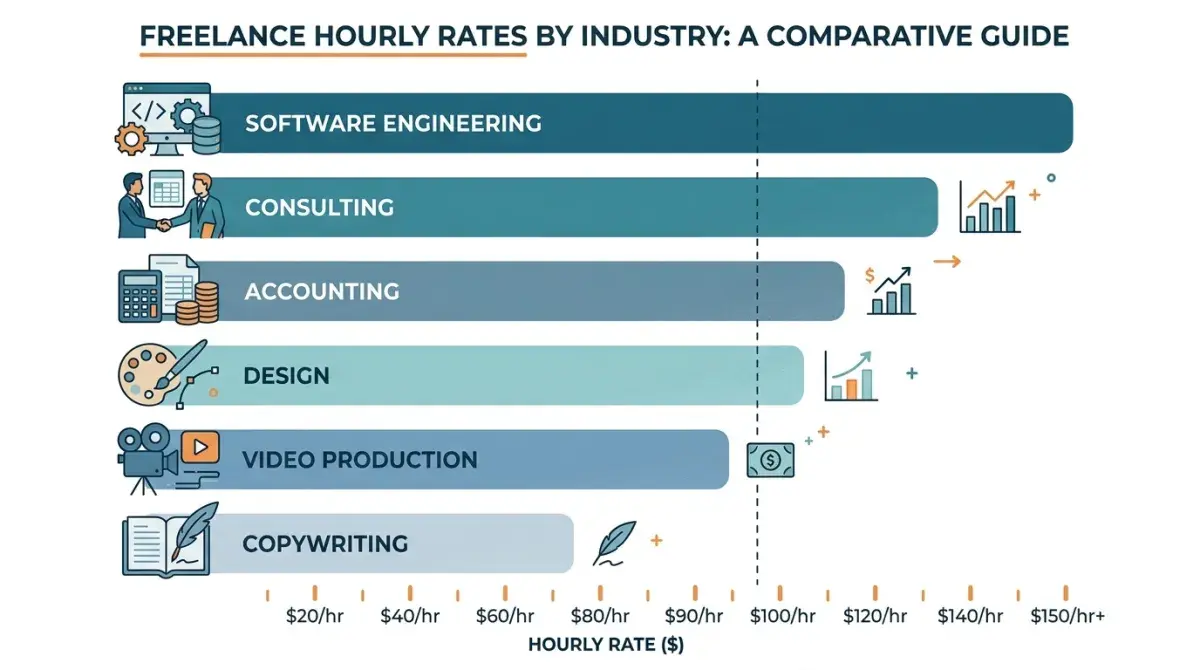
The single best predictor of freelance income is not experience, geography, or hours worked — it's industry. A senior copywriter and a senior software engineer with identical years of experience and identical 1,200 billable hours per year will end the year with radically different incomes, because the rate ceilings in their industries differ by 2-3x. Anyone setting a freelance rate without first knowing the industry-specific market benchmarks is anchoring to the wrong number.
This article compiles median and 90th-percentile freelance hourly rates across 14 industries for 2026, using data from Payoneer's 2025 Freelancer Income Report, Upwork's 2025 Talent Index, Hectic's 2025 freelancer benchmarks, Working Not Working's creative rate survey, and Dribbble's 2025 design rate report. Plug your industry-adjusted target through the freelance hourly rate calculator for a take-home estimate.
The 14-Industry Rate Table (Median Hourly, U.S., 2026)
The table below covers the 14 most common freelance industries by total practitioner count. “Median” means the 50th-percentile rate across mid-career (3-7 years experience) freelancers in the U.S.; “90th percentile” reflects what the top decile in each field charges.
| Industry | Junior (1-3 yrs) | Median (3-7 yrs) | 90th percentile |
|---|---|---|---|
| Software engineering | $45-70 | $85-115 | $165-225 |
| ML / AI engineering | $70-95 | $130-170 | $220-300 |
| Cybersecurity consulting | $65-90 | $120-160 | $200-275 |
| UX research / design | $45-65 | $75-105 | $140-180 |
| Graphic design | $35-50 | $55-75 | $95-140 |
| Brand strategy | $50-75 | $90-130 | $165-225 |
| Copywriting (general) | $25-45 | $50-75 | $120-175 |
| Technical writing | $40-60 | $70-95 | $130-175 |
| Medical / regulatory writing | $55-80 | $90-130 | $165-225 |
| Video production / editing | $30-50 | $55-85 | $120-175 |
| Accounting / bookkeeping | $30-50 | $55-85 | $120-180 |
| Marketing / SEO | $35-55 | $65-95 | $140-200 |
| Virtual assistant | $20-30 | $30-45 | $55-80 |
| Management consulting | $80-120 | $135-200 | $275-450 |
The 90th-percentile column matters more than the median for serious career planning. Within every industry, the top decile earns 2-3.5x what the median earns — and the gap is not primarily about experience. It is about specialization depth, client-tier access (Fortune 500 vs small business), and pricing confidence. The path to the 90th percentile is consistent across industries: pick a narrow specialization, target a specific client tier, and stop quoting hourly to clients who can afford project-based pricing.
Software Engineering: Why $115 Is the New Median
Software engineering freelance rates have risen ~14% since 2024 according to Payoneer's 2025 report, driven by post-LLM demand for engineers who can integrate AI tooling without breaking production systems. The median U.S. mid-career rate sits at $85-115/hr, with full-stack and backend specialists at the upper end and frontend generalists clustered at the lower end.
Specialization premiums within software:
- ML / AI engineering: +35-45% over general software. $130-170/hr median.
- Cybersecurity / pen testing: +25-35% over general software. $120-160/hr median.
- DevOps / SRE: +15-25% over general software. $100-140/hr median.
- Mobile (iOS/Android): roughly equal to general software. $80-115/hr median.
- WordPress / Shopify generalist: -25-40% under general software. $50-75/hr median.
The takeaway: within software, choosing the right sub-specialty doubles your ceiling. A senior WordPress freelancer and a senior ML engineer with the same years of experience have a 2-2.5x rate gap that no amount of negotiation will close.
Design and Creative: The Brand-Strategy Premium
Working Not Working's 2025 rate survey confirms that within the creative industries, “design” and “brand strategy” have diverged into different rate tiers. Pure execution work (logo design, social graphics, page layouts) clusters in the $55-75/hr median band. Strategy and systems work (brand architecture, design systems, UX research) commands $90-130/hr median — roughly a 60% premium.
The structural reason is that strategy work is harder to commoditize. Five hundred freelance graphic designers can produce a clean logo; fifty can build a coherent brand system for a Series B SaaS company. Buyers price accordingly. If you are a designer trying to escape the $55-75/hr range, the highest-leverage move is repositioning toward strategy rather than racing for execution speed.
Writing: The Specialization Gradient
Writing has the widest within-industry rate spread of any field on the table. Junior copywriters bill $25-45/hr; senior medical writers bill $165-225/hr at the 90th percentile — a 5-7x spread within one umbrella industry. The driver is regulatory and technical complexity:
- General copywriting: blog posts, marketing pages, social copy. $50-75/hr median.
- Conversion / direct-response copywriting: sales pages, email sequences, landing pages. $90-150/hr median.
- Technical writing: documentation, API references, developer-facing content. $70-95/hr median.
- Medical / regulatory writing: clinical trial reports, regulatory submissions, CME content. $90-130/hr median; 90th percentile $165-225/hr.
- White papers / research: long-form B2B content with original research. $85-130/hr median.
For writers, niche specialization is the highest-ROI career move. Comparing apples to apples — a senior copywriter pivoting to senior medical writer can roughly double their rate within 18-24 months, including time to build domain credentials. For the full breakdown of the freelance-rate math (the salary × 1.5 ÷ billable hours formula), see freelance hourly rate real math 2026.
Consulting: The Pricing Power Tier
Management consulting is the highest-paying freelance industry on the table — and the spread between median ($135-200/hr) and 90th percentile ($275-450/hr) is the widest in the dataset. Senior consultants from McKinsey, BCG, Bain alumni networks routinely bill $400-700/hr for executive advisory engagements; specialized strategy consultants in private equity due diligence regularly hit $500-1,000/hr for short engagements.
The consulting rate ceiling exists because consulting outputs (recommendations, frameworks, executive-level analysis) are tied directly to multi-million-dollar client decisions. A $50K consulting engagement that influences a $20M acquisition is rounding error to the buyer. This pricing power doesn't exist in execution-heavy fields like video editing or graphic design, where output is easier to commoditize.
How to Use This Table to Set Your Rate
Three-step process:
- Identify your industry row. Pick the closest match — if you straddle two (e.g., “technical writer who designs documentation interfaces”), use the higher-paying one as your anchor and discount slightly.
- Pick your experience column. Be honest. Junior = 1-3 years independent client work, median = 3-7 years, 90th percentile = 8+ years with a portfolio of brand-name clients.
- Apply the 1.5x SE-tax + overhead multiplier. The table above shows market rates clients pay. To translate that into a salary-equivalent number for your own planning, divide by 1.5 and multiply by 1,200 billable hours per year. A $95/hr median software rate × 1,200 hours = $114K gross, which translates to roughly $76K W-2 equivalent after SE tax, benefits, and overhead.
For the full per-state and per-hour breakdown including the day-rate alternative, see our freelance day rate vs hourly comparison. The freelance hourly rate calculator handles the take-home math once you know your industry rate.
When to Negotiate Above the 90th Percentile
Three conditions justify rates above the 90th percentile shown:
- Specialized buyer urgency. Client has a deadline tied to revenue (product launch, regulatory submission, M&A close). Premium of 25-50% over your normal rate is justified.
- Outcome guarantee on your part. You guarantee a measurable result (conversion lift, regulatory approval, certified compliance). Premium of 30-100% justified, but you absorb the downside risk.
- Recurring retainer with priority access. Client wants you available within 48 hours, 4-12 months at a time. Premium of 15-30% justified for the schedule constraint, plus you get income predictability.
Outside these three conditions, charging significantly above the 90th percentile usually results in losing the deal — buyers have access to the same benchmark data you have, and pricing more than 20% above market without one of these justifications signals unfamiliarity with the market rather than expertise.
What This Means for Career Pivots
The table above changes how to think about career moves within freelancing. The single highest-leverage decision is choosing which industry row to inhabit. A senior graphic designer ($55-75/hr median) considering a 12-month pivot to UX research ($75-105/hr median) is staring at a 30-40% rate uplift for the same level of seniority — far higher than any tactical pricing move within their existing field.
For training-time tradeoffs to support an industry pivot, see our hourly pay calculator to map the cost of unbilled learning weeks against your existing income, and the fitness-time tradeoff math at CalcFit's body recomp calculator for sustaining physical health through the transition period.
The Bottom Line
Freelance hourly rates by industry in 2026 span $30-450+ at the medians, with within-industry 90th-percentile premiums of 2-3.5x. The highest-paying industries — management consulting, ML/AI, cybersecurity, medical writing — pay 2-4x what the lowest-paying industries (virtual assistance, junior copywriting, basic graphic design) pay for the same seniority. Pick your industry deliberately, specialize narrowly, and negotiate based on the published benchmarks rather than your previous-industry rates. The single largest pay raise available to most freelancers is the industry pivot, not the negotiation tactic.
Use the freelance hourly rate calculator at PayScale Pro to translate your industry benchmark into a take-home number that accounts for self-employment tax, billable utilization, health insurance, and retirement.
Frequently Asked Questions
Calculate Your Freelance Take-Home
Use PayScale Pro's freelance hourly rate calculator to convert your industry benchmark rate into a net annual income after SE tax, billable utilization, and overhead.