How to Read a W-2 in 2026: Every Box Explained with Real Examples
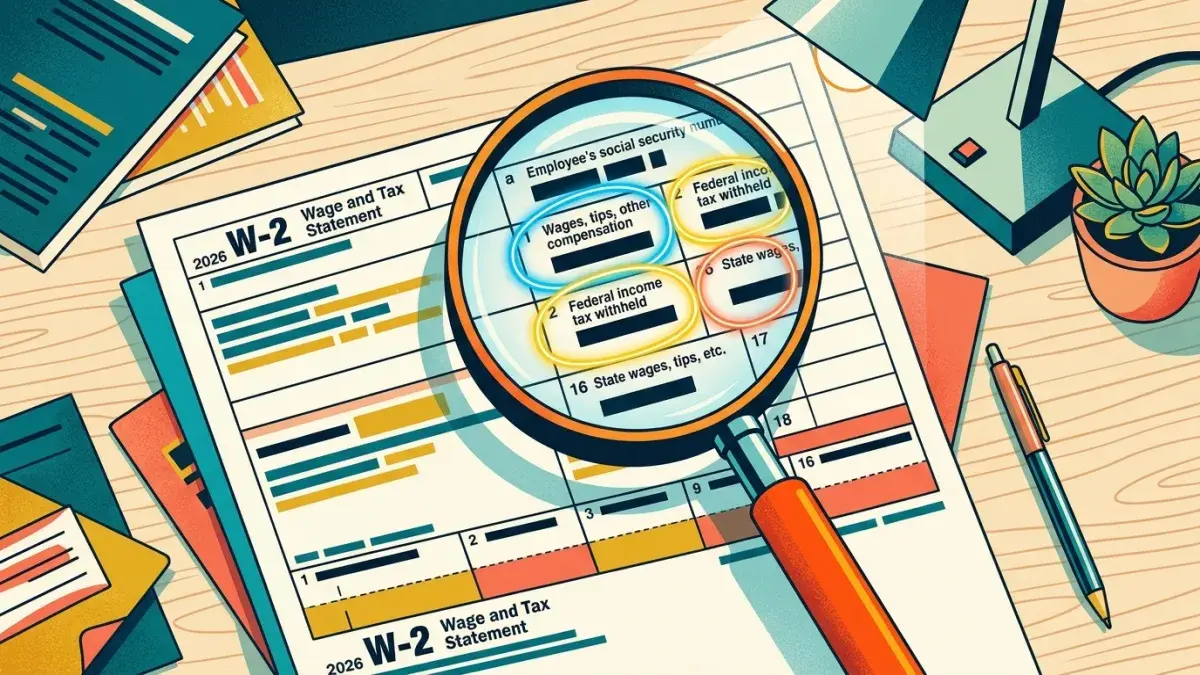
Your W-2 is the single most important tax document you receive each year, and about 70% of filing errors stem from misreading it. This guide walks through every numbered box on the 2026 W-2 with real examples, explains why Box 1 is often lower than Box 3, and shows you the Box 12 codes that affect how you file.
The Anatomy of a 2026 W-2
The W-2 has five sections: identifying information (top left boxes a through f), federal wage and tax data (boxes 1-14), and state and local data (boxes 15-20). Each employer must send you a W-2 by January 31, 2026, per IRS General Instructions for Forms W-2 and W-3.
Boxes a through f: Identifying Information
- Box a: Your Social Security Number — verify this matches your SSN card. Errors here delay refunds for months.
- Box b: Employer’s EIN (federal tax ID, 9 digits).
- Box c: Employer’s legal name and address.
- Box d: Control number (internal payroll ID, not needed for filing).
- Box e: Your legal name — must match SSA records.
- Box f: Your mailing address at time of issuance.
The Wage Boxes: 1, 3, 5, and 16
The four wage boxes look confusingly similar but track different tax bases. Here is what each one captures.
| Box | Label | What It Includes | What It Excludes |
|---|---|---|---|
| 1 | Federal taxable wages | Gross pay + taxable fringe benefits | 401(k)/403(b) pre-tax, HSA, pre-tax health, FSA |
| 3 | Social Security wages | Gross pay up to $184,500 (2026 cap) | HSA via cafeteria plan, pre-tax health, FSA |
| 5 | Medicare wages | Gross pay (no cap) | HSA via cafeteria plan, pre-tax health, FSA |
| 16 | State wages | Varies by state — often matches Box 1 | State-specific; PA/NJ/AL tax 401(k) |
Real Example: $100K Salary with Full Pre-Tax Contributions
Imagine a Colorado employee earning $100,000 who contributes $15,000 to a traditional 401(k) and $4,400 to an HSA via payroll, and pays $3,600 in pre-tax health premiums. Their W-2 will show:
- Box 1 (federal wages): $77,000 — reduced by all three pre-tax items
- Box 3 (SS wages): $92,000 — reduced by HSA and health premiums only (401(k) still counts for SS)
- Box 5 (Medicare wages): $92,000 — same as Box 3
- Box 16 (CO state wages): $77,000 — Colorado follows federal treatment
Use our take-home pay calculator to check how these deductions affect your actual paycheck before they show up on next year’s W-2.
The Tax Withheld Boxes: 2, 4, 6, and 17
These show what your employer already sent to tax authorities on your behalf. When you file, you reconcile these against what you actually owe.
- Box 2: Federal income tax withheld (determined by your W-4).
- Box 4: Social Security tax withheld = 6.2% of Box 3 (max $11,439 in 2026).
- Box 6: Medicare tax withheld = 1.45% of Box 5, plus 0.9% on wages over $200,000.
- Box 17: State income tax withheld.
If Box 4 exceeds $11,439, your employer withheld too much — you will get the overage refunded when you file. This happens when you change jobs mid-year and both employers withheld independently.
Box 12: The Codes That Matter Most
Box 12 holds up to four entries (12a, 12b, 12c, 12d). Each entry pairs a letter code with a dollar amount. Here are the codes you are most likely to see in 2026.
| Code | Meaning | Tax Impact |
|---|---|---|
| D | Traditional 401(k) contributions | Reduces Box 1, not Box 3/5. Limit: $24,500 (2026) |
| AA | Roth 401(k) contributions | No tax reduction. Informational only. |
| DD | Cost of employer health coverage | Informational, not taxable. |
| W | HSA contributions (employer + employee) | Reduces Box 1, 3, and 5. Limit: $4,400 single / $8,750 family |
| E | 403(b) pre-tax contributions | Reduces Box 1, not Box 3/5. |
| G | 457(b) pre-tax contributions | Reduces Box 1, not Box 3/5. |
| BB | Roth 403(b) contributions | No tax reduction. |
| EE | Roth 457(b) contributions | No tax reduction. |
| S | SIMPLE IRA contributions | Reduces Box 1. Limit: $16,500 (2026) |
| T | Employer-paid adoption benefits | Partial exclusion up to $17,810 (2026) |
The 2026 401(k) contribution limit of $24,500 is published in IRS Notice 2025-78. The 2026 HSA limits of $4,400 (self) and $8,750 (family) are set by Revenue Procedure 2025-19. Roth vs. traditional 401(k) math is covered in our Roth vs Traditional 401(k) guide.
Box 13: Three Checkboxes That Change Your Taxes
- Statutory employee: Rare. Applies to certain driver salespersons, insurance agents, and home workers. Reports income on Schedule C instead of Form 1040.
- Retirement plan: Checked if you were an active participant. Limits your deductible traditional IRA contribution if your income is above the phase-out threshold ($89,000 single / $143,000 joint in 2026).
- Third-party sick pay: Some wages came from an insurance company, not your employer.
Box 14: The Catchall
Box 14 is a free-form box where employers report items that do not fit elsewhere. You might see:
- CA-SDI or SDI: California State Disability Insurance (1.1% of wages in 2026 with no cap — see the California take-home pay guide).
- NY SDI, NJ SDI, RI TDI: State disability insurance in those states.
- RRTA: Railroad Retirement Tax Act contributions.
- Union dues, uniform costs, parking: Employer-specific items.
- 401(k) loan repayment: Usually informational.
California SDI and similar state disability withholdings are deductible on your federal Schedule A if you itemize, subject to the SALT cap of $10,000.
State and Local Boxes: 15 through 20
Boxes 15-20 repeat for each state and locality where you worked.
- Box 15: State abbreviation and employer’s state ID.
- Box 16: State wages. Use this on your state return, not Box 1.
- Box 17: State income tax withheld.
- Box 18: Local wages (e.g., New York City, Philadelphia).
- Box 19: Local income tax withheld.
- Box 20: Locality name.
Pennsylvania, New Jersey, and Alabama do not allow 401(k) pre-tax exclusion. That means a $100K salary with $15K in 401(k) would show Box 1 = $85,000 but Box 16 = $100,000 in those states. Check our state-by-state take-home pay guide for the full list.
Red Flags to Check Before Filing
1. Name and SSN Match SSA Records
About 2% of W-2s arrive with mismatched names or SSNs. The SSA publishes a free online Social Security Number Verification Service that your employer can use. If you recently married, divorced, or adopted a new name, your SSA record might not be updated — the W-2 should still match SSA, not your driver’s license.
2. Box 4 Does Not Exceed $11,439
If it does, you had two or more employers and overpaid Social Security. Claim the excess on Schedule 3, Line 11 of Form 1040.
3. Box 12 Codes Add Up
Compare your final paycheck stub to Box 12. If your stub shows $24,500 in 401(k) contributions and Box 12 code D shows $22,000, ask HR for a corrected W-2c. The $1,500 gap could mean the employer reported December’s check in the next tax year.
4. Multiple W-2s Consolidate Correctly
If you changed jobs, stack all W-2s side-by-side. Sum Box 1 across all of them — that is your total federal wages. Do the same for Boxes 2, 3, 4, 5, and 6. Tax software does this automatically, but always double-check against the sum on your final stubs.
What Is New on the 2026 W-2
The IRS has not changed the layout of Form W-2 since 2022, but three things to know for 2026:
- Social Security wage base rose to $184,500 (from $176,100 in 2025), per SSA 2026 Cost-of-Living Adjustment.
- 401(k) elective deferral limit rose to $24,500. Catch-up contribution for age 50+ is $7,500; new SECURE 2.0 super catch-up for ages 60-63 is $11,250.
- HSA limits: $4,400 self, $8,750 family; catch-up $1,000 for age 55+.
Using Your W-2 to Estimate Next Year’s Refund
Your W-2 is the clearest signal for whether your 2026 W-4 is set correctly. If Box 2 was much higher than your actual tax owed, you are giving the IRS an interest-free loan. If it was much lower, you could owe an underpayment penalty. See our guide on when to update your W-4 and use the take-home calculator to forecast your full year. For salaried pay frequency math, start with the salary calculator.
Last verified: April 20, 2026. Sources: IRS Form W-2 General Instructions (2026 version), IRS Revenue Procedure 2025-19 (HSA limits), IRS Notice 2025-78 (retirement plan limits), and SSA 2026 Cost-of-Living Adjustment.
Frequently Asked Questions
Check Your 2026 Take-Home Pay
Use what you learned from your W-2 to forecast 2026 net pay. Adjust 401(k), HSA, and filing status to see exactly what lands in your account each pay period.
Open Take-Home Calculator →