What Is the Difference Between Gross Pay and Net Pay?
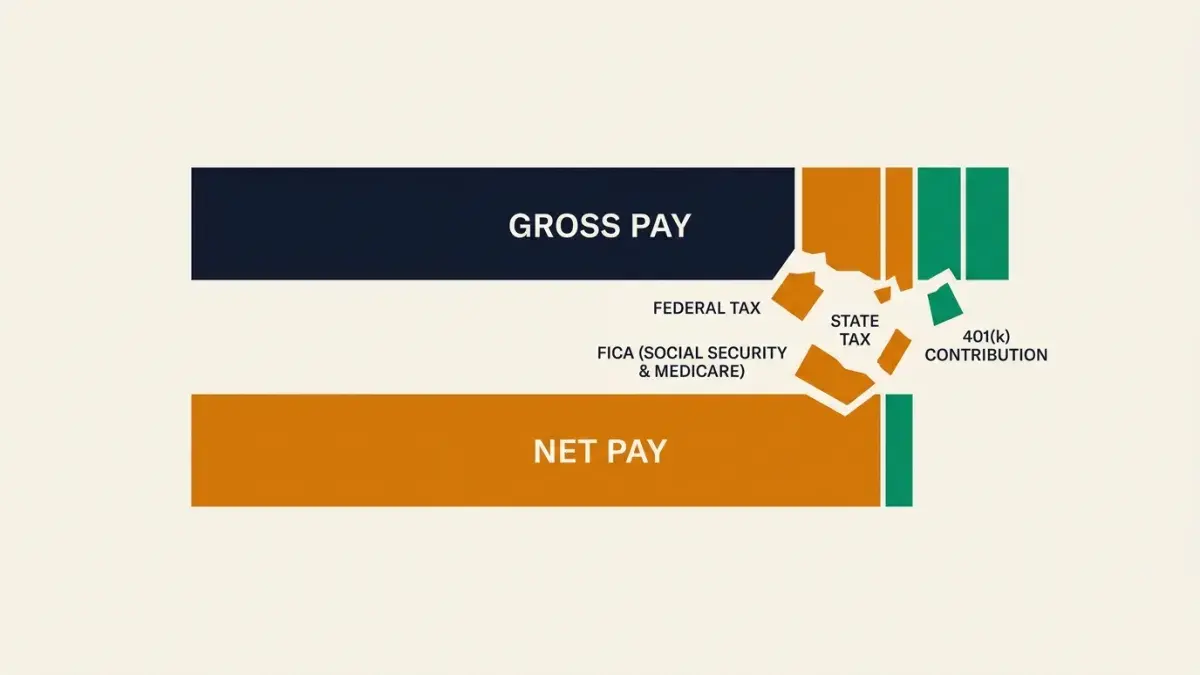
Gross pay is your total earnings before any deductions — the full salary or hourly wages you were promised. Net pay, also called take-home pay, is what actually reaches your bank account after taxes and other deductions come out. The difference between them is everything withheld from your paycheck: federal income tax, state income tax, Social Security (6.2%), Medicare (1.45%), and voluntary deductions like 401(k) contributions or health insurance premiums. For a typical US worker, net pay is roughly 70–85% of gross pay.
It is the single most common paycheck confusion: you accept a $70,000 job and the deposit is nowhere near $70,000 ÷ 26. That gap is not an error — it is the machinery of payroll taxes and benefits doing exactly what it is supposed to. Here is precisely what separates the two numbers, in the order the deductions actually happen.
Gross Pay: The Starting Number
Gross pay is the sum of everything you earned in a pay period, before a single dollar is subtracted. For a salaried worker it is your annual salary divided by the number of pay periods; for an hourly worker it is your rate multiplied by hours worked. Critically, gross pay includes all compensation, not just base wages:
- Regular salary or hourly wages
- Overtime pay (see how overtime pay is calculated)
- Bonuses and commissions
- Tips and shift differentials
- Holiday and paid-time-off pay
This is the figure a job offer quotes, the number on your employment contract, and the base that lenders and landlords use to qualify you. It is also the number the IRS starts from before applying deductions to reach taxable income.
Net Pay: What You Actually Take Home
Net pay is gross pay minus every deduction. The deductions fall into three buckets, and the order matters because pre-tax items shrink the base that taxes are calculated on.
The Three Layers Between Gross and Net
1. Pre-tax deductions. These come out first and lower your taxable wages. Traditional 401(k) contributions, Health Savings Account (HSA) contributions, and pre-tax health, dental, and vision premiums all qualify. According to the IRS, the 2026 elective 401(k) deferral limit is $24,500. Every dollar routed here reduces the income that federal and state tax are computed on.
2. Taxes. After pre-tax deductions, three taxes apply to what remains:
- Federal income tax — progressive, from 10% to 37%, withheld using the IRS Publication 15-T tables based on your W-4.
- FICA — a flat 7.65%: Social Security at 6.2% up to the 2026 wage base of $184,500 per the Social Security Administration, and Medicare at 1.45% on all wages (plus an extra 0.9% on wages over $200,000).
- State income tax — 0% in nine states, up to 13.3% at the top of California’s brackets.
3. Post-tax deductions. These come out after taxes and do not reduce taxable income: Roth 401(k) contributions, court-ordered wage garnishments, union dues, and after-tax insurance. What remains after all three layers is your net pay.
The Formula
Put simply:
- Taxable wages = Gross pay − pre-tax deductions
- Net pay = Taxable wages − federal tax − state tax − FICA − post-tax deductions
For the full line-by-line of what leaves each check, see how much taxes are taken out of my paycheck, and for how FICA and income tax differ, see FICA vs federal income tax.
Gross vs Net at Different Salaries
Approximate annual net pay for a single filer in a no-income-tax state, taking the standard deduction and no 401(k) contributions. Your exact figure depends on state, filing status, and deductions — run it in the take-home pay calculator.
| Gross Salary | Est. Federal Tax | FICA (7.65%) | Approx. Net Pay | % Kept |
|---|---|---|---|---|
| $40,000 | $2,600 | $3,060 | $34,340 | 85.9% |
| $60,000 | $5,000 | $4,590 | $50,410 | 84.0% |
| $80,000 | $8,300 | $6,120 | $65,580 | 82.0% |
| $100,000 | $12,200 | $7,650 | $80,150 | 80.2% |
| $150,000 | $23,900 | $11,289 | $114,811 | 76.5% |
| $250,000 | $50,400 | $13,187 | $186,413 | 74.6% |
FICA stops rising at the $184,500 Social Security wage base, which is why the percentage kept flattens at higher incomes even as income tax climbs.
Which Number Should You Use?
Use gross pay when a form asks for income: mortgage applications, rental qualification (landlords commonly want gross income of 40× the monthly rent), credit card applications, and comparing job offers. Use net pay for one thing only, but it is the important one: budgeting. Your net pay is the money you can actually spend and save, so a budget built on gross income will always run short. If you are deciding how much house you can afford, start from net — our sister site breaks down what a mortgage really costs in the true cost of a $400K mortgage.
Sources and Methodology
401(k) and pre-tax contribution limits: IRS retirement contribution limits. Federal withholding method: IRS Publication 15-T. Social Security wage base: Social Security Administration — Contribution and Benefit Base. Medicare rates: IRS Topic 751. Net-pay estimates computed with the same 2026 federal bracket and FICA engine as the take-home calculator. Last updated July 12, 2026.
Frequently Asked Questions
See Your Gross-to-Net Breakdown
Enter your salary or hourly rate, filing status, and state. The calculator shows your gross pay, each deduction, and your exact net take-home pay per paycheck. Free and instant.
Open Take-Home Pay Calculator →