How Is Overtime Pay Calculated?
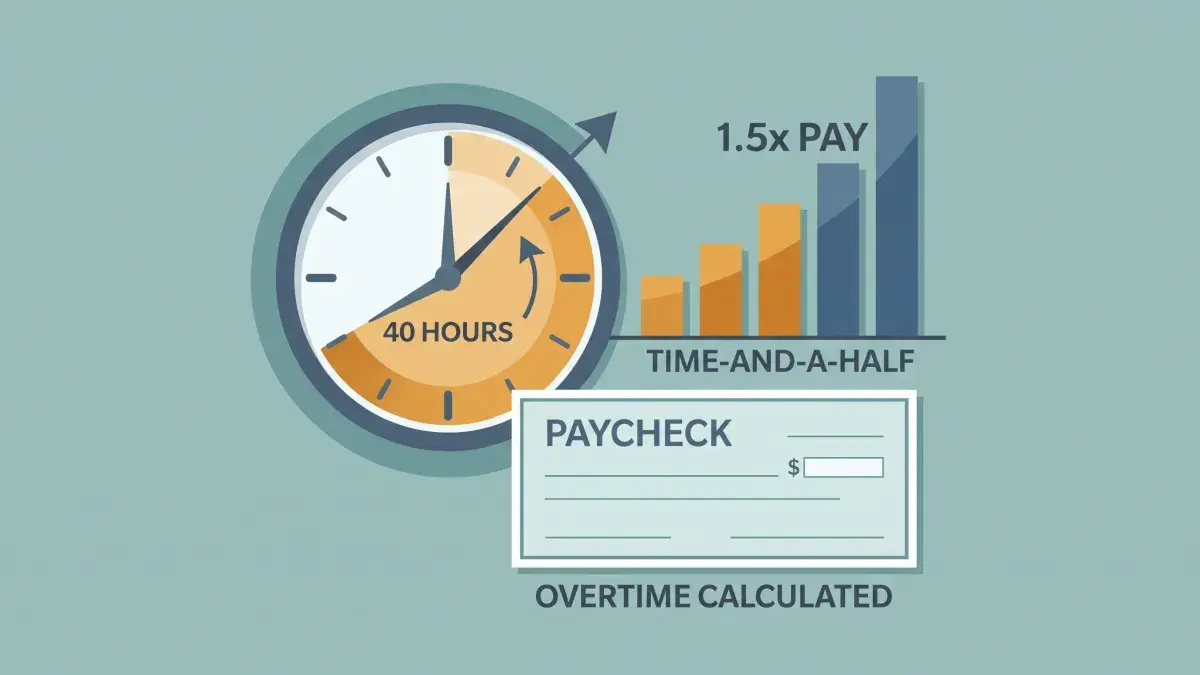
Overtime pay is calculated at 1.5× your regular rate of pay for every hour worked over 40 in a single workweek, under the federal Fair Labor Standards Act (FLSA). The formula is: overtime pay = regular hourly rate × 1.5 × overtime hours. A $20/hour employee who works 45 hours earns $20 × 1.5 = $30 per overtime hour × 5 hours = $150 in overtime, on top of $800 straight-time pay, for a $950 week. Federal law requires overtime only over 40 hours per week — not for long days or weekends — unless a stricter state law applies.
The rule sounds simple, and for a plain hourly worker it is. The complications come from the definition of “regular rate,” salaried non-exempt workers, bonuses, and state daily-overtime rules. Here is the full calculation, straight from the US Department of Labor.
The Federal Overtime Formula
The US Department of Labor (dol.gov/agencies/whd/overtime) sets the rule: non-exempt employees must be paid at least time-and-a-half for hours over 40 in a workweek. In two steps:
- Overtime rate = regular hourly rate × 1.5
- Overtime pay = overtime rate × hours over 40
Your total for the week is straight-time pay for the first 40 hours plus the overtime pay for the rest. A workweek is any fixed, recurring 168-hour (7-day) period your employer sets — it does not have to be Monday–Sunday, but it cannot shift week to week to dodge overtime.
Worked Examples at Every Hourly Rate
Overtime rate and pay for common wages, assuming a straight base rate and time-and-a-half:
| Regular Rate | Overtime Rate (1.5×) | 5 OT Hours | 10 OT Hours | Total for a 50-Hour Week |
|---|---|---|---|---|
| $15.00 | $22.50 | $112.50 | $225.00 | $825.00 |
| $18.00 | $27.00 | $135.00 | $270.00 | $990.00 |
| $20.00 | $30.00 | $150.00 | $300.00 | $1,100.00 |
| $25.00 | $37.50 | $187.50 | $375.00 | $1,375.00 |
| $30.00 | $45.00 | $225.00 | $450.00 | $1,650.00 |
| $40.00 | $60.00 | $300.00 | $600.00 | $2,200.00 |
| $50.00 | $75.00 | $375.00 | $750.00 | $2,750.00 |
The 50-hour column is 40 hours at the regular rate plus 10 hours at the overtime rate. Run your own numbers in the overtime pay calculator.
The Catch: What Counts as the “Regular Rate”
The biggest calculation mistake is using base wage when the law requires the regular rate. Per DOL regulation 29 CFR §778, the regular rate must fold in nondiscretionary bonuses, shift differentials, and commissions, then divide by total hours worked. Example: $20/hour plus a $100 weekly production bonus, 45 hours worked.
- Straight-time earnings: (45 × $20) + $100 = $1,000
- Regular rate: $1,000 ÷ 45 = $22.22
- Overtime premium (the extra half): 0.5 × $22.22 × 5 = $55.56
- Total week: $1,000 + $55.56 = $1,055.56
Discretionary bonuses, holiday gifts, and expense reimbursements are excluded from the regular rate. Get the inclusion wrong and you underpay overtime — one of the most common and costly wage-and-hour violations.
Overtime for Salaried (Non-Exempt) Employees
Being on salary does not automatically waive overtime. A salaried worker is owed overtime if they earn below the FLSA salary threshold ($58,656/year under the 2024 DOL rule) or fail the duties test. To calculate, convert the salary to an hourly regular rate:
- $50,000 salary meant to cover a 40-hour week
- Weekly salary: $50,000 ÷ 52 = $961.54
- Regular rate: $961.54 ÷ 40 = $24.04
- Overtime for 10 extra hours: 1.5 × $24.04 × 10 = $360.60
For who qualifies as exempt versus non-exempt and the state thresholds, see our 2026 overtime pay rules guide. To sanity-check what a salary works out to per hour in the first place, use the hourly-to-salary converter.
State Rules That Change the Math
The FLSA is a floor. Some states are more generous, and the more-generous rule wins:
| State | Overtime Trigger | Double-Time Trigger |
|---|---|---|
| Federal (FLSA) | Over 40 hrs/week | None |
| California | Over 8 hrs/day or 40/week | Over 12 hrs/day, or over 8 hrs on 7th consecutive day |
| Alaska | Over 8 hrs/day or 40/week | None |
| Colorado | Over 12 hrs/day or 40/week | None |
| Nevada | Over 8 hrs/day (under 1.5× min wage) or 40/week | None |
Is Overtime Taxed More? No.
Overtime is taxed at your normal marginal rate — the IRS does not have a special overtime rate. A single big paycheck can look over-taxed because withholding tables annualize the spike, but you recover the difference at filing. FICA applies the same way. For the full picture of what leaves every check, see how much taxes are taken out of my paycheck and FICA vs federal income tax.
Turning Overtime Into Long-Term Money
Overtime is one of the fastest ways to boost income, but only if it goes somewhere. Routing consistent overtime into savings or retirement compounds — our sister site breaks down the target in how much do I need to retire.
Sources and Methodology
Overtime rules and the 40-hour standard: US Department of Labor, Wage and Hour Division — Overtime. Regular-rate inclusions: DOL Fact Sheet 56A (29 CFR §778). Salary threshold: DOL 2024 overtime final rule. Tax treatment of overtime: IRS Publication 15-T. State rules from each state’s labor department. Last updated July 8, 2026.
Frequently Asked Questions
Calculate Your Overtime Instantly
Enter your hourly rate, regular hours, and overtime hours. The calculator returns your regular pay, overtime pay at 1.5× or 2×, and total for the week. Free and instant.
Open Overtime Calculator →