How Is a PTO Payout Taxed?
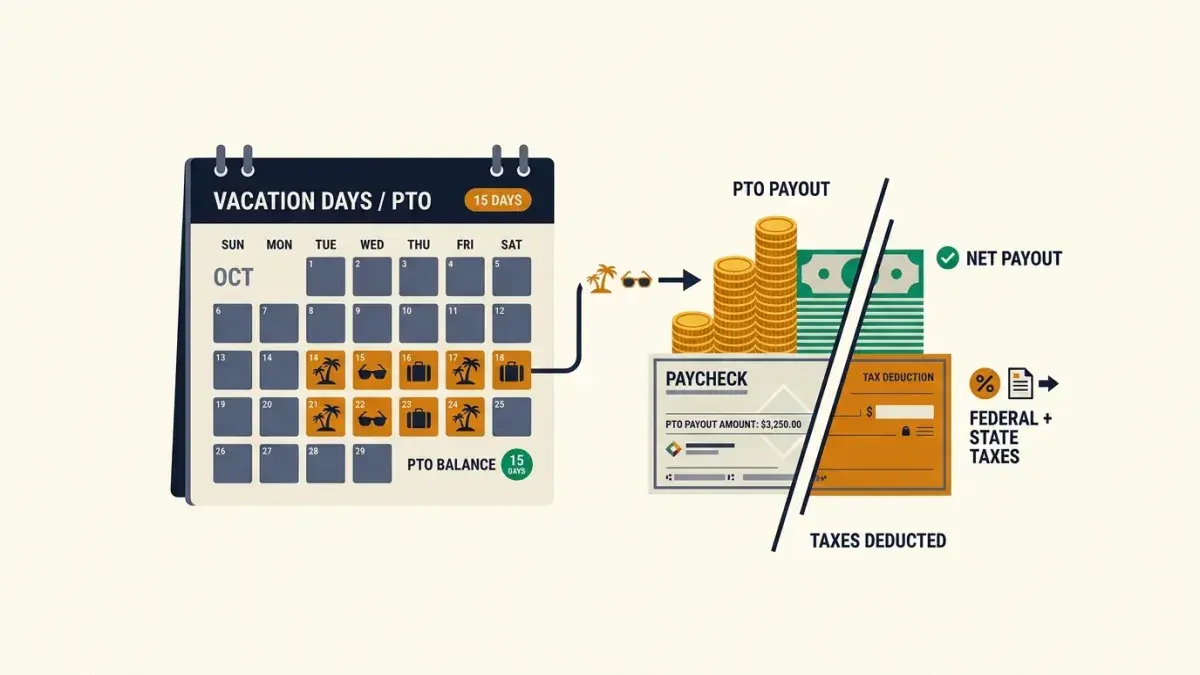
A PTO payout — unused vacation or paid time off cashed out, usually when you leave a job — is taxed as ordinary income, exactly like your regular wages. The IRS treats it as “supplemental wages,” so your employer withholds federal income tax at a flat 22% rate (or lumps it into a regular check), plus FICA at 7.65% (6.2% Social Security and 1.45% Medicare) and any state income tax. It is not taxed at a special higher rate; the withholding just looks bigger than usual and evens out when you file.
The “my PTO payout got destroyed by taxes” complaint is one of the most common paycheck myths. The money is not taxed more — it is withheld more aggressively, and the difference comes back at tax time. Here is exactly how the payout is taxed, why the withholding looks steep, and what the state rules are.
Why It Is Taxed as “Supplemental Wages”
The IRS defines supplemental wages as compensation paid outside your regular salary — bonuses, commissions, severance, and payouts of accumulated sick leave or vacation. Per IRS Publication 15 (Employer’s Tax Guide), a PTO payout falls squarely in this category. That classification only affects withholding method, not the ultimate tax rate. Your employer can use one of two approaches:
- Percentage (flat-rate) method: withhold a flat 22% federal on the payout, rising to 37% on any supplemental wages above $1 million in a calendar year. This is the most common approach for a separate payout check.
- Aggregate method: add the payout to your most recent regular paycheck and withhold as if the combined amount were your normal pay — which often pushes withholding into a higher tier temporarily.
The Full Tax Stack on a Payout
Three things come out of a PTO payout, the same three that come out of any paycheck:
- Federal income tax — withheld at 22% (flat method), but ultimately taxed at your marginal bracket (10%–37%) once the payout is added to your annual income.
- FICA — 6.2% Social Security up to the 2026 wage base of $184,500 per the Social Security Administration, plus 1.45% Medicare on all of it (and 0.9% extra above $200,000).
- State income tax — from 0% in no-tax states to 13.3% in California; many states also apply their own flat supplemental rate.
Worked Example: A $3,250 Payout
Say you leave a job with 15 unused PTO days at a daily rate of roughly $217 (a ~$56,400 salary), for a $3,250 payout, in a no-income-tax state using the flat method:
| Line | Rate | Amount |
|---|---|---|
| Gross PTO payout | — | $3,250.00 |
| Federal withholding (supplemental) | 22% | −$715.00 |
| Social Security | 6.2% | −$201.50 |
| Medicare | 1.45% | −$47.13 |
| Net payout | — | $2,286.37 |
That is about 70% take-home. If your real marginal bracket is 12% rather than 22%, roughly $325 of the federal withholding comes back as a refund when you file. Model your own number in the bonus tax calculator, which uses the same supplemental-wage math.
Why the Withholding Looks So High
A flat 22% federal withholding is higher than the effective rate most middle-income workers actually pay. When your regular checks are withheld at 10–12% and a payout is suddenly hit at 22%, it feels punitive. But withholding is a prepayment, not the tax itself. At filing, the payout is folded into your total income, taxed at your true rate, and any excess withholding is refunded. This is the same mechanism that makes bonuses feel over-taxed — covered in depth in how supplemental wages are taxed and how much taxes are taken out of my paycheck.
State Rules: Does Your Employer Even Have to Pay It Out?
Federal law is silent here. The US Department of Labor confirms the Fair Labor Standards Act does not require payment for unused vacation or PTO — it is governed by state law and employer policy. The states split into three camps:
| State Approach | Rule | Examples |
|---|---|---|
| Accrued PTO = earned wages | Must be paid out; “use-it-or-lose-it” forfeiture banned | California, Colorado, Illinois, Montana |
| Pay out if policy promises it | Enforced only if the employer’s written policy provides for payout | New York, Texas (mixed), most states |
| No state requirement | Entirely up to employer policy | Florida, Georgia, Alabama |
Whatever your state requires, once the money is paid it is taxed identically — as supplemental wages.
Timing Can Change Your Bracket
You cannot change the tax rate on a payout, but timing changes the bracket it lands in. A payout received in a low-income year — the year you retire, or a gap between jobs — may be taxed far less than the same payout on top of a full year’s salary. If you have the choice, and especially if the payout is large, a low-income year is the cheapest time to take it. Putting the after-tax proceeds to work matters just as much: our sister site breaks down the target in how much do I need to retire.
Sources and Methodology
Supplemental wage classification and the 22%/37% withholding rules: IRS Publication 15 (Circular E), Employer’s Tax Guide, section 7. Federal withholding tables: IRS Publication 15-T. Social Security wage base: Social Security Administration — Contribution and Benefit Base. State payout requirements: US Department of Labor — Vacation Leave and each state’s labor department. Last updated July 12, 2026.
Frequently Asked Questions
Estimate the Tax on Your Payout
A PTO payout is taxed like a bonus. Enter the payout amount and your state in the bonus tax calculator to see federal withholding, FICA, and your net cash. Free and instant.
Open Bonus Tax Calculator →