Supplemental Wages Tax 2026: How Bonuses, Commissions, RSUs, and Severance Are Withheld
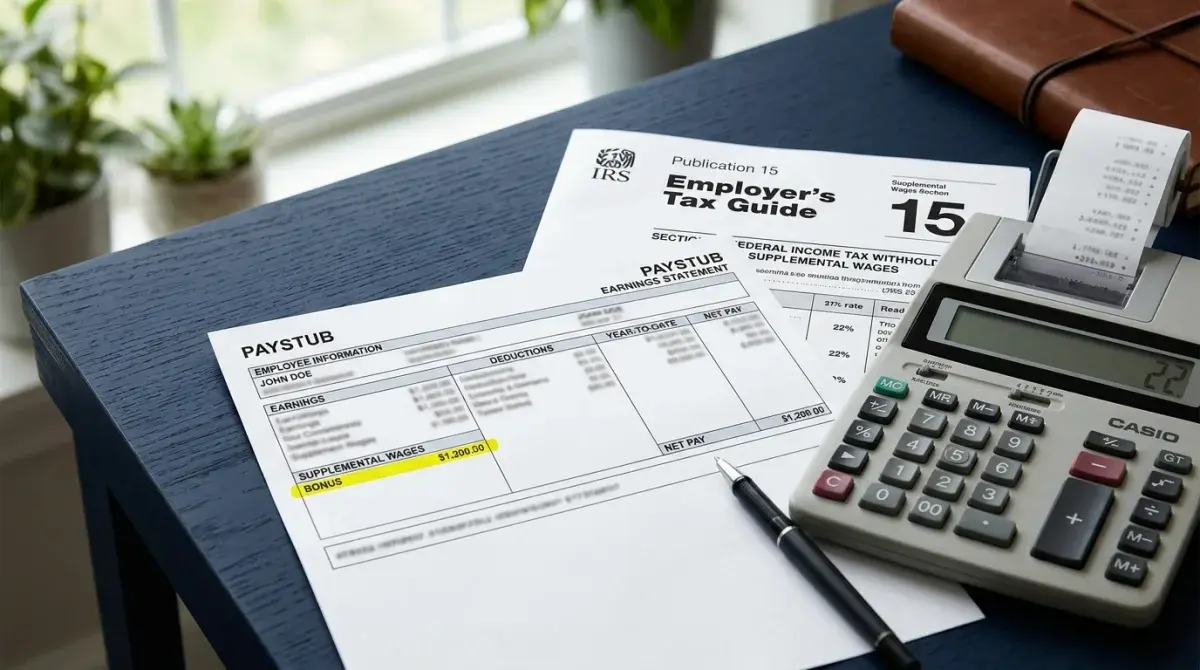
The phrase “supplemental wages” sounds technical, but it controls why your $10,000 bonus check shows up at $7,035, why a quarterly RSU vest looks smaller than the FMV implies, and why a commission paycheck always feels like it gets carved up worse than your salary. The IRS treats roughly a dozen different income types as supplemental — and they all get hit with a flat 22% federal withholding rate before any other math runs. Here is the complete 2026 picture, with citations and the exact take-home numbers by state.
What Counts as Supplemental Wages
IRS Publication 15 (Circular E), Section 7 defines supplemental wages as compensation paid in addition to an employee’s regular wages. The full list:
- Bonuses (cash, signing, performance, retention, holiday)
- Commissions (sales, override, residual)
- Overtime pay (technically supplemental, usually run as aggregate)
- Accumulated sick leave or vacation payout
- Severance pay
- Back pay and retroactive raises
- Awards, prizes, and recognition payments
- Vested stock (RSUs, performance shares)
- ESPP discounts treated as wages
- Taxable fringe benefits (excess group-term life, personal use of company car)
- Nonaccountable expense allowances
- Tips reported to the employer (Form 4070)
- Nondeductible moving expense reimbursements
Salary and standard hourly wages — what shows up as your “regular gross” — go through the normal wage-bracket withholding tables (Pub 15-T) at your W-4 elections. Everything else in the list above gets routed through supplemental withholding rules.
The Two Methods Employers Can Use
Percentage Method (Most Common)
When supplemental wages are identified separately on the paystub, the employer can withhold federal income tax at a flat 22%. Treas. Reg. § 31.3402(g)-1(a)(7) authorizes this method. Almost every Fortune 500 payroll system defaults to it because it is clean and automatable.
Aggregate Method (Less Common)
The employer adds the supplemental payment to your most recent regular paycheck, runs the combined amount through the regular wage-bracket tables, then subtracts what was already withheld from the regular pay — leaving the excess as the supplemental withholding. This usually pulls a higher percentage than 22% on bonuses because the imputed annualized income temporarily looks larger. Smaller employers using off-the-shelf payroll software sometimes use this method by default.
The $1 Million Mandatory 37% Rule
Once your cumulative supplemental wages from a single employer exceed $1,000,000 in a calendar year, the excess MUST be withheld at 37% — the top federal marginal rate. This is mandatory under Treas. Reg. § 31.3402(g)-1(a)(2) and the employer cannot opt out, regardless of method. Splitting payments across calendar years is the cleanest way to avoid crossing the threshold.
FICA Still Applies — And It Stacks
The 22% federal flat rate is income tax only. Supplemental wages are also subject to FICA (Federal Insurance Contributions Act), which has not changed in structure for 2026:
| Tax | Rate | Wage Base / Threshold (2026) |
|---|---|---|
| Social Security | 6.2% employee | $184,500 wage base (per SSA) |
| Medicare | 1.45% | No cap |
| Additional Medicare | 0.9% | YTD wages over $200K single / $250K joint |
For a typical mid-career W-2 employee under the SS wage base and under $200K YTD, FICA on a supplemental payment is 6.2% + 1.45% = 7.65%. Stacked on top of 22% federal income, that is 29.65% before any state tax.
State Supplemental Rates That Stack on Top
42 states have an income tax. 36 of those have published a flat supplemental withholding rate. Here are the 2026 rates:
| State | 2026 Supplemental Rate | Notes |
|---|---|---|
| California | 10.23% (15.99% stock) | Per EDD; SDI 1.1% uncapped also applies |
| New York | 11.7% | NYC adds 4.25%; Yonkers adds 1.61% |
| Massachusetts | 5.0% | Plus 4% surtax on income above $1M |
| Illinois | 4.95% | Flat rate |
| Pennsylvania | 3.07% | Plus local EIT (typically 1-3%) |
| New Jersey | 11.8% (over $1M) | Tiered; uses regular tables for under $500K |
| Oregon | 8% | Plus Portland Metro 1%, TriMet 0.0079 |
| Minnesota | 6.25% | Flat for supplemental |
| Colorado | 4.4% | Flat |
| Georgia | 5.39% | Flat |
| Arizona | 2.5% | Flat (lowest non-zero) |
| FL, TX, NV, WA, TN, SD, WY, AK, NH | 0% | No state income tax |
Run the exact numbers for your state in the bonus tax calculator, and check our deep-dives on California take-home pay and Texas take-home pay.
Worked Example: $10,000 Bonus, Three States
| Line Item | Texas | California | New York (NYC) |
|---|---|---|---|
| Gross | $10,000 | $10,000 | $10,000 |
| Federal 22% | −$2,200 | −$2,200 | −$2,200 |
| SS 6.2% | −$620 | −$620 | −$620 |
| Medicare 1.45% | −$145 | −$145 | −$145 |
| State supplemental | $0 | −$1,023 | −$1,170 |
| City supplemental | $0 | $0 | −$425 |
| CA SDI 1.1% | $0 | −$110 | $0 |
| Net | $7,035 | $5,902 | $5,440 |
| Effective rate | 29.65% | 40.98% | 45.60% |
RSUs vs Cash Bonuses: Same Federal, Different State
Federal treatment is identical: 22% up to $1M, 37% above. The differences are in state and in the mechanics:
- California: 15.99% on stock-based supplemental wages vs. 10.23% on cash. A $50K RSU vest in CA is withheld 5.76 percentage points harder than the equivalent cash bonus.
- Sell-to-cover under-withholding: Most employers automatically sell-to-cover at 22% federal, which is correct only if your marginal bracket is 22%. If you are in the 24% or 32% bracket (very common for senior tech and finance roles where RSUs are large), the standard sell-to-cover leaves you owing 2-15% more at tax time. Use Form W-4 Step 4(c) to add extra withholding on regular pay.
- FICA on RSUs: Vested shares trigger Social Security (6.2% up to wage base) and Medicare (1.45%) at vest, just like cash. The employer typically sells additional shares to cover this.
- 83(b) elections do not apply to RSUs. They apply only to restricted stock awards (RSAs). RSUs cannot be elected into early.
See our bonus tax 2026 deep-dive and bonus tax state-by-state guide for more state-specific math.
Severance Pay and the Quality Stores Rule
The Supreme Court's 2014 decision in United States v. Quality Stores, Inc. (572 U.S. 141) settled that severance payments are subject to FICA — a question that had been litigated for decades. So severance gets:
- Federal: 22% flat (or 37% above $1M cumulative)
- FICA: 7.65% (up to wage base for SS)
- State: Per state supplemental rate
For severance packages of $200K+, splitting the payment across two calendar years can keep cumulative supplemental wages below $1M and may keep marginal bracket lower each year. Negotiate this in the separation agreement; payroll cannot do it after the fact.
How to Reduce Supplemental Withholding (Legally)
1. 401(k) Bonus Deferral
Many employer 401(k) plans allow a separate deferral percentage on bonuses — sometimes up to 100%. Defer the full bonus into your traditional 401(k) (within the 2026 limit of $24,500, or $32,500 with catch-up if 50+) and you avoid all federal AND state income tax on that portion. FICA still applies. Net cost: 7.65% to park the entire amount tax-deferred.
2. HSA Through Payroll
A Section 125 cafeteria-plan HSA contribution dodges federal income tax, state income tax, AND FICA. The 2026 HSA limit is $4,400 self-only / $8,750 family ($1,000 catch-up at 55+). If your bonus arrives when you have HSA room, redirect what you can.
3. Time Across Calendar Years
For very large supplemental payments (executive bonuses, RSU mega-vests, severance), splitting across two calendar years keeps you below the $1M / 37% threshold and may keep marginal bracket lower each year.
4. Adjust W-4 Step 4(c)
If your marginal bracket is 24% or higher, the 22% supplemental withholding under-withholds by 2-15%. Use Form W-4 Step 4(c) to add extra dollars per pay period to cover the gap. See our guide on updating your W-4 for the timing.
Common Misconceptions
“Bonuses are taxed at a higher rate than regular income.” No. They are withheld at 22%. Your real tax is calculated on full annual income at your real marginal bracket. Withholding is an estimate; tax owed is calculated at year-end.
“If I take the bonus as a check instead of through payroll, I avoid the 22%.” No. Any compensation from an employer is W-2 wages and triggers Pub 15 supplemental withholding regardless of payment method.
“Independent contractor 1099 income is supplemental.” No. 1099 income is not employer-paid wages, so Pub 15 does not apply. 1099 contractors pay self-employment tax (15.3%) plus federal/state income tax via quarterly estimated payments. See our quarterly estimated taxes guide for that workflow.
Sources
Federal supplemental withholding rules: IRS Publication 15 (Circular E), Section 7 and Treas. Reg. § 31.3402(g)-1. 2026 federal brackets: IRS Revenue Procedure 2025-11. Social Security wage base: SSA Contribution and Benefit Base. California rates: California EDD 2026 withholding tables. New York rates: NY Pub NYS-50. Severance/FICA: United States v. Quality Stores, 572 U.S. 141 (2014).
Educational, not tax advice. Consult a CPA for your specific situation. Last verified May 10, 2026.
For a fitness-side complement on stacking small habits the way this post stacks small tax rules, see our partner site's creatine timing review.
Frequently Asked Questions
Calculate Your Exact Bonus or Commission Take-Home
Enter the supplemental amount, regular salary, and state to see exactly what hits your account — with all 2026 federal, FICA, and state supplemental rates baked in.
Open Bonus Tax Calculator →