How Many Paychecks Are in a Year? (Weekly, Biweekly, Semi-Monthly, Monthly)
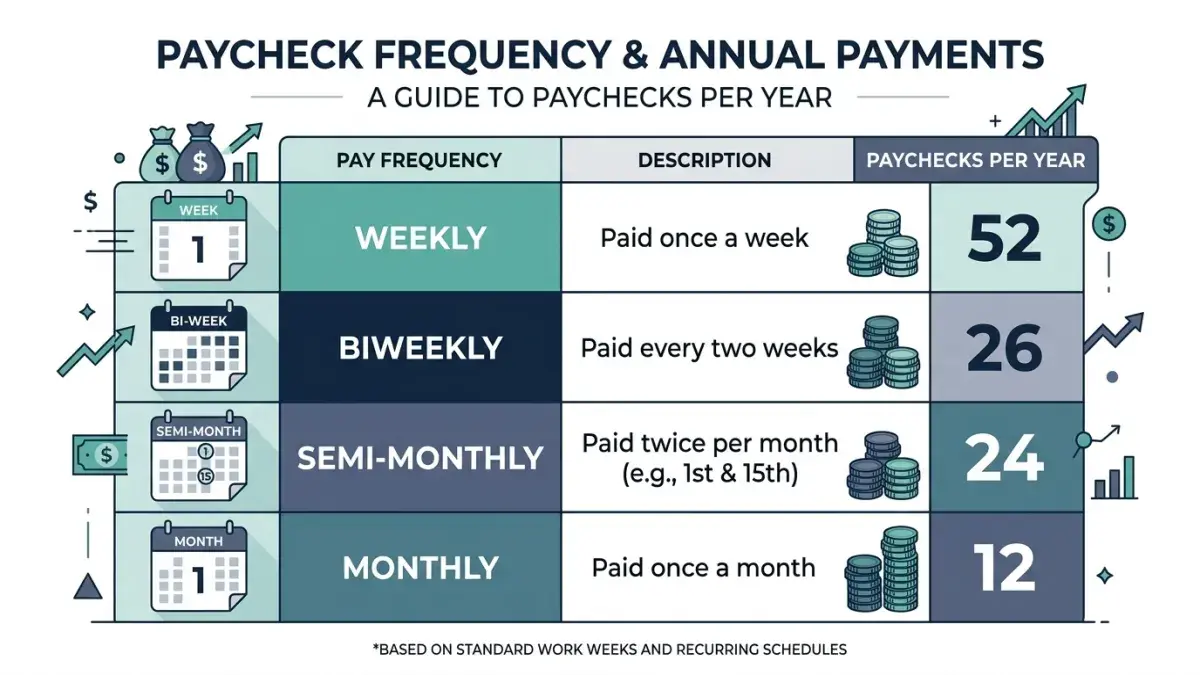
The number of paychecks in a year depends on your pay frequency: weekly = 52, biweekly = 26 (occasionally 27), semi-monthly = 24, and monthly = 12. Weekly and biweekly schedules run on a 7- or 14-day cycle, so in some calendar years they land one extra paycheck (a 53- or 27-paycheck year). Semi-monthly and monthly are anchored to the calendar month, so they are fixed at 24 and 12 every single year. Here is the full reference, why the extra-paycheck years happen, and what it means for your budget and benefits.
Paychecks Per Year: The Reference Table
| Pay frequency | Paychecks per year | How it’s counted | Per check on $60,000 | Extra-check year? |
|---|---|---|---|---|
| Weekly | 52 | Once every 7 days | $1,154 | Yes — 53 in some years |
| Biweekly | 26 | Once every 14 days | $2,308 | Yes — 27 in some years |
| Semi-monthly | 24 | Twice a month (e.g. 1st & 15th) | $2,500 | No — always 24 |
| Monthly | 12 | Once a month | $5,000 | No — always 12 |
Per-check amounts are simply your annual salary divided by the paycheck count. Plug in your own salary and pay frequency in the salary calculator to see exact gross and net figures.
Weekly: 52 Paychecks
A weekly schedule pays once every 7 days. There are 52 weeks in a year, so you get 52 paychecks. Weekly is common in construction, trades, and some hourly and union jobs because it keeps cash flowing and aligns tightly with the workweek used for overtime. On a $60,000 salary, each weekly check is $60,000 ÷ 52 = $1,154 gross.
Biweekly: 26 Paychecks (Sometimes 27)
A biweekly schedule pays every 14 days: 52 weeks ÷ 2 = 26 paychecks. Biweekly is the most common pay frequency in U.S. private industry, according to the U.S. Bureau of Labor Statistics. On a $60,000 salary, each biweekly check is $60,000 ÷ 26 = $2,308 gross. Two months each year contain three biweekly paydays, which is why some checks feel like a bonus. For the deeper 14-days-vs-twice-a-month contrast, see biweekly vs semi-monthly pay.
Semi-Monthly: 24 Paychecks
Semi-monthly means twice per calendar month, typically the 1st and 15th (or the 15th and last day). That is 2 × 12 = exactly 24 paychecks, every year, with no extra-check quirk. On a $60,000 salary, each semi-monthly check is $60,000 ÷ 24 = $2,500 gross. Because paydays are tied to the month, they line up neatly with rent and bills due on the 1st and 15th.
Monthly: 12 Paychecks
A monthly schedule pays once per month — 12 paychecks a year. It is the least common frequency in U.S. private industry and is limited in several states by minimum pay-frequency laws under the U.S. Department of Labor state payday requirements, many of which mandate at least semi-monthly pay. On a $60,000 salary, each monthly check is $60,000 ÷ 12 = $5,000 gross.
The 27-Paycheck (and 53-Paycheck) Year Explained
Here is the wrinkle that trips people up. A biweekly schedule pays every 14 days, so 26 checks cover 26 × 14 = 364 days. But a calendar year has 365 days (366 in a leap year). That leaves the biweekly cycle one day short each year — two in a leap year:
- 26 biweekly checks × 14 days = 364 days
- A normal year is 365 days; a leap year is 366 days
- The schedule runs 1–2 days short annually, and that gap banks over time
- Roughly every 11 years, the accumulated shortfall slides an extra pay date inside the calendar year, producing a 27-paycheck year
Weekly payers hit the identical quirk: 52 × 7 = 364 days, so the one-day annual gap eventually lands a 53rd weekly paycheck. Semi-monthly and monthly schedules never do this, because they are counted by the month (always 24 or 12), not by a fixed number of days.
Whether a given year has 27 (or 53) checks is employer-specific — it depends on the pay weekday and when the first check of the cycle falls relative to January 1. For the full calendar math, three ways employers handle the extra check, and the tax and withholding impact, read how biweekly pay works and why some years deliver 27 paychecks.
How Paycheck Count Affects Budgeting
More paychecks does not mean more annual income — it means smaller, more frequent deposits. But the count changes how you budget:
- Weekly and biweekly spread money into more, smaller checks and deliver occasional “extra” paychecks (53rd/27th) that make excellent forced savings, IRA, or debt-payoff money.
- Semi-monthly and monthly deliver fewer, larger checks on fixed calendar dates that line up cleanly with the 1st and 15th when most bills come due.
To convert between frequencies and see your take-home per check on any schedule, use the take-home pay calculator.
How Paycheck Count Affects Benefits and 401(k)
Per-check deductions — 401(k), HSA, and insurance premiums — multiply by the number of paychecks, so pay frequency changes your annual totals. If your 401(k) is a percentage of each check, a 27-paycheck year automatically raises your annual contribution by about 3.85%; watch the IRS annual limit so you do not overshoot. Withholding is calculated per pay period from IRS Publication 15-T tables, and Social Security is capped once your wages hit the annual taxable maximum set by the Social Security Administration — the cap is annual, so pay frequency does not change when you reach it. Semi-monthly (24) and monthly (12) counts are steady year to year, which makes benefit planning simpler than a schedule that occasionally jumps to 27 or 53.
Sources and Methodology
Pay-frequency prevalence: U.S. Bureau of Labor Statistics, “How frequently do private businesses pay workers?” and BLS Current Employment Statistics: Length of pay periods. Minimum pay-frequency law: U.S. Department of Labor, State Payday Requirements. Per-period withholding: IRS Publication 15-T. Social Security annual wage base: SSA Contribution and Benefit Base. Paycheck counts derived from the Gregorian calendar (52 weeks; 26 × 14 = 364 days). Last updated July 4, 2026.
Frequently Asked Questions
Convert Your Salary to Any Pay Frequency
See your exact take-home per check on weekly, biweekly, semi-monthly, and monthly schedules — and how a 26- vs 27-paycheck year changes your cash flow.
Open Salary Calculator →