What Is OASDI on My Paycheck?
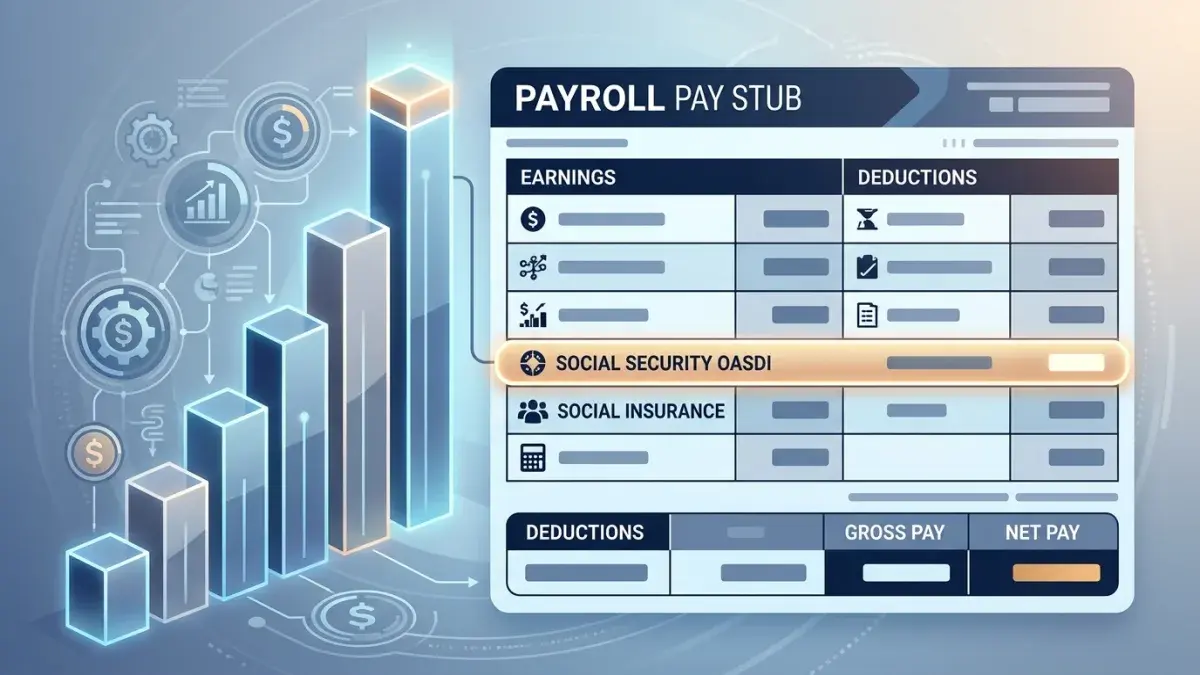
OASDI stands for Old-Age, Survivors, and Disability Insurance. It is the formal name for the Social Security tax. It is withheld at a flat 6.2% of your wages, your employer quietly pays a matching 6.2%, and it only comes out up to a yearly income ceiling. That is the whole thing — the rest is detail about the label and the cap.
The reason it shows up as an unfamiliar acronym rather than “Social Security” is that payroll software prints the program’s legal name. The three words even tell you what it pays for: benefits for the old (retirement), for survivors, and for the disabled.
The 6.2% rate, and the half you never see
Employees pay 6.2% of gross wages toward OASDI. Your employer pays another 6.2% that never appears on your stub, so the government collects 12.4% on your wages in total. Medicare is a separate, smaller tax on top of it. Per IRS Topic No. 751, these rates have been unchanged for years; what changes is the ceiling below.
Why OASDI stops mid-year: the wage base
OASDI is only charged up to an annual limit called the wage base, or taxable maximum. Once your year-to-date wages cross it, no more Social Security tax is withheld for the rest of the calendar year, and your take-home pay goes up. It resets every January 1. It is formally the “contribution and benefit base” because the same ceiling also caps the earnings that count toward your future benefit — wages above it are neither taxed for OASDI nor credited toward what you’ll be paid.
| Year | Wage base | Max employee OASDI (6.2%) |
|---|---|---|
| 2022 | $147,000 | $9,114.00 |
| 2023 | $160,200 | $9,932.40 |
| 2024 | $168,600 | $10,453.20 |
| 2025 | $176,100 | $10,918.20 |
| 2026 | $184,500 | $11,439.00 |
So in 2026, the most any single employer can withhold from you for OASDI is $11,439. If you earn below the wage base — which is the large majority of workers — the cap never comes into play and 6.2% is taken from every paycheck all year.
This cap is a common hidden reason for a paycheck that changes size late in the year for high earners: OASDI switches off while Medicare, which has no cap, keeps going.
What “OASDI/EE” means
The EE means employee — it is your share of the tax. The matching employer share is ER, which shows on the employer’s records rather than your stub. Depending on the payroll provider, the same line can read “Fed OASDI/EE”, “Soc Sec”, “SS”, or plainly “Social Security.” They are all the identical 6.2% tax.
OASDI vs Medicare vs FICA
These three names describe overlapping things, which is where the confusion starts.
- FICA is the umbrella — the Federal Insurance Contributions Act — and it is OASDI plus Medicare together.
- OASDI is the Social Security half: 6.2%, capped at the wage base.
- Medicare (labeled HI or “Fed MED/EE”) is the other half: 1.45% with no cap, plus an extra 0.9% on wages over $200,000.
If your stub lists a “FICA” line instead of two separate lines, it is the two combined — typically 7.65% (6.2% + 1.45%) until you hit the OASDI cap.
OASDI vs federal income tax withholding
They are unrelated deductions that people lump together. OASDI is a flat 6.2% that does not care about your W-4 or your tax bracket. Federal income tax withholding is separate: it depends on your W-4 elections and the IRS wage-bracket tables, and it is reconciled on your return, where you can be refunded or owe. OASDI does not work that way — the main exception is that if two jobs together push you past the wage base, the excess Social Security tax is credited back on your return.
One more look-alike: CA SDI
“OASDI” and “SDI” are one letter apart and often appear on the same California stub. CA SDI is California’s State Disability Insurance — a state program funding short-term disability and paid family leave — not the federal Social Security tax. If you work in California you can be paying both at once.
If you’re self-employed
You pay both halves. Because a self-employed person is simultaneously the employee and the employer, the OASDI portion of self-employment tax is the full 12.4% up to the same wage base, collected through SECA rather than payroll withholding. Half of it is deductible against income tax. See quarterly estimated taxes for how that is actually paid.
Sources
- Social Security Administration, Contribution and Benefit Base — the annual wage base, including the $184,500 figure for 2026.
- Internal Revenue Service, Topic No. 751, Social Security and Medicare Withholding Rates — the 6.2% OASDI rate, the 1.45% Medicare rate, and the 0.9% Additional Medicare Tax.
- Social Security Administration, What is FICA? — how OASDI and Medicare together make up FICA.
General information, not tax advice. The 2026 figures above were confirmed against the SSA and IRS sources on 16 September 2026; rates and the wage base change from year to year.