What Does Paid in Arrears Mean?
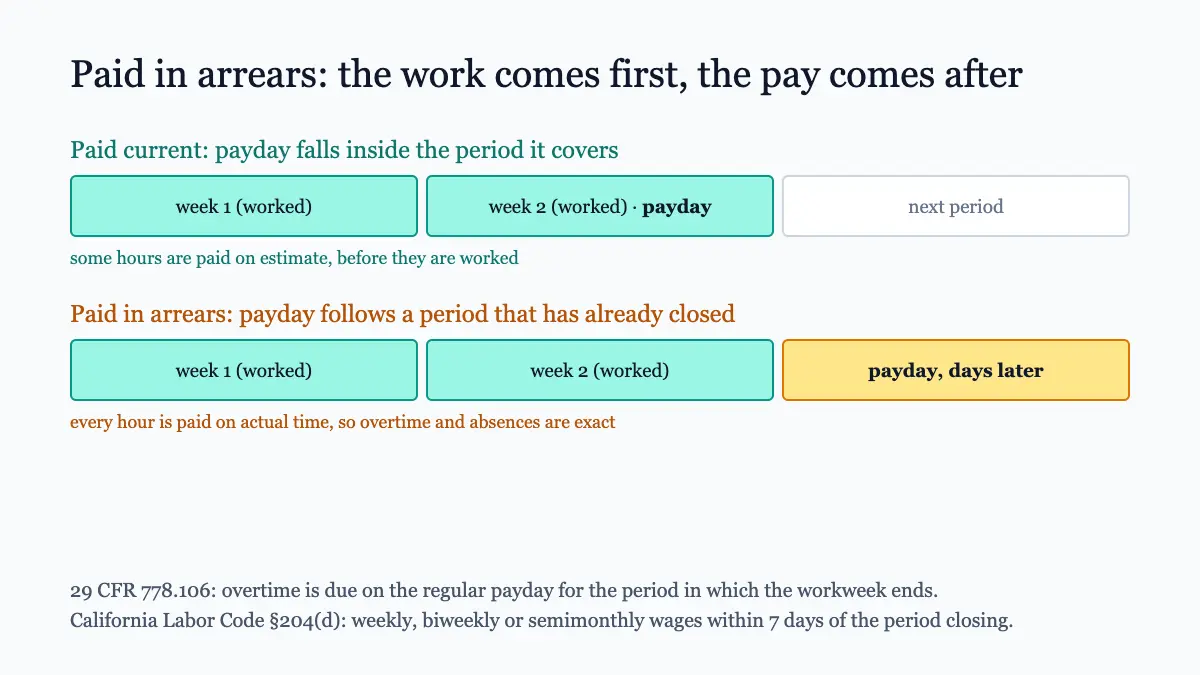
Being paid in arrears means you are paid after the pay period ends, for work you have already done. Friday’s paycheck covers a period that has already closed, not the days you are working now. It is how most hourly payroll runs, and it does not mean you are owed money or behind on anything.
“Arrears” sounds like debt, and in a loan or a rent agreement it does mean an overdue payment. On a paycheck it only describes timing: the pay trails the work. Nothing is late and nothing is missing.
Paid in arrears vs paid current
The alternative is being paid current, where payday falls inside the period it covers. The difference is whether any of the check pays for time you have not worked yet.
| Paid in arrears | Paid current | |
|---|---|---|
| Payday falls | After the period closes | Inside the period |
| Covers days not yet worked? | No | Yes, usually the last few |
| Overtime and absences | Paid exactly, from real timesheets | Estimated, then corrected on a later check |
| Typical for | Hourly staff, weekly or biweekly payroll | Salaried staff on semimonthly or monthly payroll |
| First paycheck | Arrives after the first full period plus the lag | Can arrive within the first period |
A worked example. Your biweekly pay period runs Monday 1st to Sunday 14th, and payday is Friday 19th. That Friday pays for the 1st through the 14th. The days you work from the 15th onward are paid on Friday 2nd of the next cycle. You are always one period plus a few days behind, and that stays constant for as long as you are on that payroll.
Why the lag exists
Payroll cannot pay an hour until someone knows it was worked. Between the end of the period and payday, timesheets are closed and approved, overtime and deductions are calculated, taxes are withheld, and the direct deposit is funded, which takes a day or two to settle between banks. Paying in arrears gives that work a fixed window. Paying current would mean guessing at hours and fixing the guess on the next check, which is exactly how paychecks end up different every week.
Why your first paycheck takes longest
Your first period has to close before it can be paid, and the lag applies on top of that. Start on a Wednesday in the middle of a biweekly period, and your first check covers only the days from Wednesday to the period’s end. It arrives on the payday after that period closes. From your start date that can be two to three weeks. That is the most common reason people search “why is my first paycheck delayed”: nothing went wrong, the arrears lag is just longest at the start. If the payday has passed and the money is still missing, that is a different problem. See why hasn’t my paycheck deposited.
What the law allows
Paying in arrears is legal. The limits are on how long the lag may be, and most of them come from the states.
- Federal: the FLSA does not set a pay frequency. It does require overtime earned in a workweek to be paid on the regular payday for the period in which that workweek ends. If the overtime can’t be calculated in time, it may be delayed only as long as reasonably necessary, and never past the next payday after it can be computed (29 CFR 778.106).
- California: wages are due at least twice each calendar month (Labor Code §204(a)). Weekly, biweekly or semimonthly payroll satisfies the rule if wages are paid within seven calendar days after the payroll period closes (§204(d)).
- New York: manual workers must be paid weekly, with semimonthly pay allowed only with approval. Clerical and other workers can be paid semimonthly.
- Texas: employees exempt from FLSA overtime must be paid at least monthly. Everyone else must be paid at least twice a month.
- Florida: has no state payday-frequency rule, so only the federal overtime timing applies.
The U.S. Department of Labor keeps a state-by-state table of these rules (linked below). If your lag is much longer than your state allows, raise it with payroll first, then with your state labor department.
You don’t lose the lag when you leave
The period you worked last is paid on your final paycheck. The lag moves your pay later. It never removes any of it. If you’re budgeting around the first check at a new job, plan for the gap. The paycheck calculator will show what that first check should come to once it arrives.
Sources
- Electronic Code of Federal Regulations, 29 CFR 778.106, Time of payment — overtime due on the regular payday for the period in which the workweek ends.
- California Legislative Information, Labor Code §204 — twice-monthly paydays and the seven-day rule for weekly, biweekly and semimonthly payroll.
- U.S. Department of Labor, Wage and Hour Division, State Payday Requirements — the pay-frequency rules for New York, Texas, Florida and every other state.
General information, not legal advice. The rules above were checked against the linked federal, California and Department of Labor sources on 26 September 2026. State payday laws change, and several states have exceptions for particular industries.