Why Are Paychecks Biweekly?
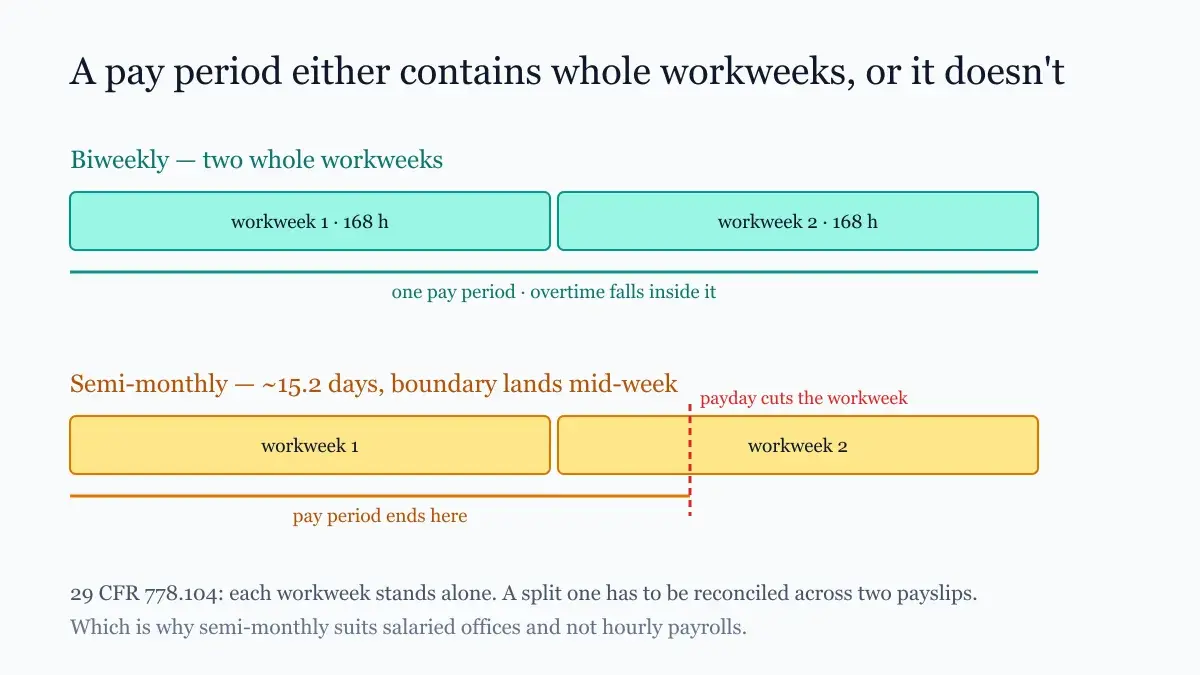
Because two weeks is the shortest pay period that is both a whole number of workweeks and cheap enough to run. No federal law requires any particular frequency — but federal law does fix the workweek, and overtime is computed inside it. A biweekly period is exactly two of them. Semi-monthly is not a whole number of anything.
Federal law sets no pay frequency at all
This surprises people who assume biweekly is a legal default. The Fair Labor Standards Act sets a minimum wage and overtime rules; it does not say how often you must be paid. The federal requirement is regularity — wages are due on the regular payday for the period the work fell in.
Frequency is a matter of state law, and it varies. Some states require at least semi-monthly payment, some set different floors for different classes of worker, and some say very little. Your state labor department publishes the rule that actually governs you; it is the only one that does.
What federal law does fix: the workweek
Here is the piece that explains the pattern. Overtime is not computed over a month, or a pay period, or an average. It is computed over a workweek, and the regulation defines that precisely.
“An employee’s workweek is a fixed and regularly recurring period of 168 hours — seven consecutive 24-hour periods.”
— 29 CFR 778.105
And each one is judged on its own, under 29 CFR 778.104: a workweek stands alone, so hours cannot be averaged across two of them to avoid overtime. Fifty hours one week and thirty the next is ten hours of overtime, not a tidy eighty.
That is the constraint the pay period has to live with. If your pay period contains a whole number of workweeks, every overtime calculation falls neatly inside one payslip. If it does not, workweeks straddle the boundary and have to be tracked across two.
Why semi-monthly is awkward, and for whom
| Frequency | Periods / year | Whole workweeks? | Payday lands on |
|---|---|---|---|
| Weekly | 52 | Yes — one | same weekday |
| Biweekly | 26 (sometimes 27) | Yes — two | same weekday |
| Semi-monthly | 24 | No — ~15.2 days | moves around the week |
| Monthly | 12 | No | fixed date |
A semi-monthly period averages about 15.2 days, so its boundaries fall mid-week by design. Every month, at least one workweek is cut in half by a payday. For salaried staff that costs nothing, because no overtime arithmetic is involved. For an hourly payroll it is a recurring reconciliation. That is the whole reason semi-monthly is common in salaried offices and rare on shop floors — not tradition, arithmetic.
So why not weekly?
Weekly satisfies the workweek rule perfectly and is better for the employee, because money arrives sooner and more often. It is simply twice as expensive to run: each payroll cycle carries fixed processing, filing and reconciliation costs, and 52 of them cost roughly double 26.
Biweekly is a compromise, and it is the payer’s compromise. It is the cheapest schedule that keeps overtime clean. Worth saying plainly, because it is usually presented as a neutral convention rather than a cost decision.
The leftover day, and the 27th paycheck
Twenty-six biweekly periods cover 364 days. A year is 365, or 366 in a leap year. That spare day accumulates, and roughly every eleven years a 27th payday lands inside the calendar year. Nothing has gone wrong and no one has gained a bonus — a salary is being divided into 27 payments instead of 26, so each is slightly smaller unless the employer handles it another way. We worked the arithmetic through in the 27-paycheck year.
What to check on your own payslip
Two things. First, whether your employer has designated a workweek at all — it must be fixed and recurring, and it does not have to start on Monday or at midnight. Second, whether your pay period boundary matches it. If you are hourly and your period is semi-monthly, overtime for a split workweek is the calculation most likely to be wrong, and it is the one worth checking against your own hours.
General information, not legal advice, and not specific to any state. Regulatory citations were read from the eCFR on 6 September 2026. Pay-frequency requirements are set by state law and change; your state labor department publishes the rule that applies to you.
Related
- Biweekly vs semi-monthly pay
- Why some years have 27 paychecks
- How many paychecks are in a year?
- How is overtime pay calculated?