What Is the Medicare Tax on My Paycheck?
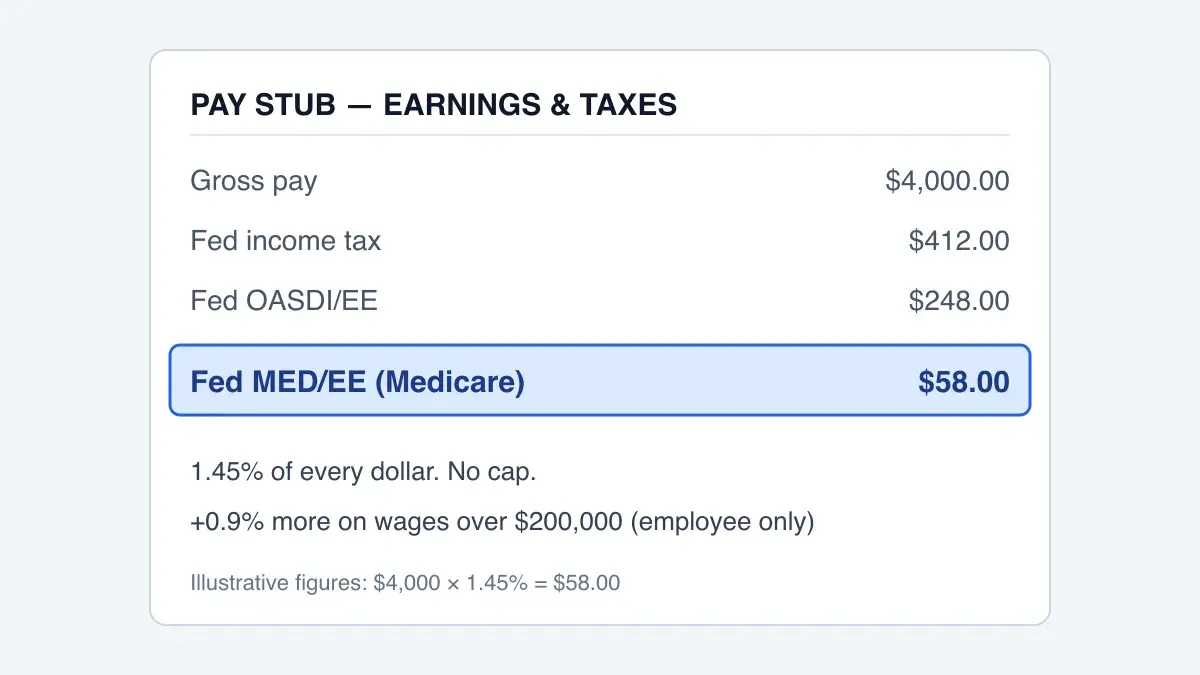
The Medicare tax is 1.45% of every dollar of your gross pay, with no yearly cap. Your employer pays a matching 1.45% you never see. Earn more than $200,000 in a year and an extra 0.9% is withheld on the amount above that. It is the hospital insurance half of FICA, and unlike Social Security it never switches off mid-year.
It usually appears as Fed MED/EE, Medicare, or HI (Hospital Insurance). “EE” means employee: your share. The employer’s matching share, “ER”, sits on their books instead.
The 1.45% rate and how it adds up
Per IRS Topic No. 751, the Medicare rate is 1.45% for the employee and 1.45% for the employer, 2.9% in total. It applies to all covered wages, which is why the math is so simple: multiply gross pay by 0.0145.
| Annual wages | Medicare (1.45%) | Additional 0.9% | Total employee Medicare |
|---|---|---|---|
| $50,000 | $725 | $0 | $725 |
| $100,000 | $1,450 | $0 | $1,450 |
| $200,000 | $2,900 | $0 | $2,900 |
| $300,000 | $4,350 | $900 | $5,250 |
| $500,000 | $7,250 | $2,700 | $9,950 |
| $1,000,000 | $14,500 | $7,200 | $21,700 |
The 0.9% applies only to the portion over $200,000, so the $300,000 row is $4,350 plus 0.9% of $100,000. These are employee-side withholding figures; the employer match is separate and the 0.9% has none.
Why Medicare never stops mid-year
IRS Topic No. 751 is explicit: only the Social Security tax has a wage base limit ($184,500 for 2026). “There’s no wage base limit for Medicare tax. All covered wages are subject to Medicare tax.” So when a high earner’s OASDI deduction stops in the fall and take-home pay rises, the Medicare line is still there on every check.
The 0.9% Additional Medicare Tax
Employers must begin withholding the Additional Medicare Tax in the pay period in which your wages for the year exceed $200,000, and continue each pay period through December. This is based on wages from that one employer and ignores your filing status. There is no employer match.
Your real liability is worked out on Form 8959 with your return, and the threshold there does depend on filing status: $250,000 married filing jointly, $125,000 married filing separately, and $200,000 for everyone else (IRS Topic No. 560). That mismatch between the withholding rule and the filing rule is where surprises come from.
The married-couple surprise
Take two spouses who each earn $150,000 and file jointly. Neither employer withholds the 0.9%, because neither person passed $200,000. But together they earned $300,000, which is $50,000 over the $250,000 joint threshold, so they owe 0.9% of $50,000, $450, when they file. Nothing on any paycheck warned them. The opposite also happens: a single earner at $210,000 has 0.9% of $10,000 ($90) withheld, which is correct, while a joint filer with a non-working spouse and the same pay has $90 withheld that they would not actually owe, since $210,000 is under $250,000. They get it back through Form 8959 as a credit.
If you expect to owe, Topic No. 560 notes you can ask your employer to withhold extra income tax on a Form W-4 or make estimated tax payments.
Medicare vs Social Security vs FICA
- FICA is the umbrella: Social Security plus Medicare. A combined FICA line is typically 7.65% (6.2% + 1.45%).
- Social Security (OASDI): 6.2%, capped at the wage base.
- Medicare: 1.45%, no cap, plus the 0.9% extra above the threshold.
Neither is federal income tax. For how those differ, see FICA vs federal income tax, and for the full list of what leaves a check, how much tax is taken out of your paycheck.
If you’re self-employed
You are both employee and employer, so you pay the combined 2.9% as part of self-employment tax, plus the 0.9% Additional Medicare Tax above your filing-status threshold. See quarterly estimated taxes.
Check your own numbers
Our take-home pay calculator shows the FICA and Medicare lines for your salary so you can compare them with your stub.
Sources
- Internal Revenue Service, Topic No. 751, Social Security and Medicare withholding rates — the 1.45% employee and employer rates, and the absence of a Medicare wage base limit.
- Internal Revenue Service, Topic No. 560, Additional Medicare tax — the 0.9% rate, the $200,000 employer withholding trigger, the $250,000 / $125,000 / $200,000 filing thresholds, and Form 8959.
General information, not tax advice. Rates and thresholds were confirmed against the IRS pages above on 13 October 2026. The worked examples are our own arithmetic.